Conversion of Galvanometer
Product Code : SCL-EAE-11201
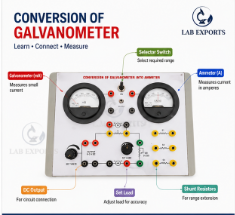
Quick answer: The Conversion of Galvanometer apparatus is used for the senior physics practical of converting a galvanometer into an ammeter, with a low shunt resistance in parallel, and into a voltmeter, with a high resistance in series. Students first find the galvanometer resistance and figure of merit, then calculate and test the required resistance. Lab Exports manufactures it in Delhi for schools, colleges and universities.
Specifications
| Parameter | Detail |
|---|---|
| Experiment 1 | Galvanometer to ammeter: low shunt resistance in parallel |
| Experiment 2 | Galvanometer to voltmeter: high resistance in series |
| Supporting measurements | Galvanometer resistance and figure of merit |
Meter range, resistance values and the list of supplied parts are not listed on this page; email [email protected] with the house code for the current configuration.
How the conversion experiment is done
A galvanometer gives full-scale deflection for a very small current Ig and has a coil resistance G. To read a larger current I, a shunt S = Ig G/(I - Ig) is connected in parallel so that most of the current bypasses the coil. To read a voltage V, a resistance R = V/Ig - G is connected in series so that full-scale deflection corresponds to V.
- Find the galvanometer resistance G, for example by the half-deflection method.
- Find the figure of merit and the full-scale current Ig from the number of scale divisions.
- Calculate the shunt for the required ammeter range, or the series resistance for the required voltmeter range.
- Connect the calculated resistance and check the converted meter against a standard ammeter or voltmeter.
- Record any difference and compare the calculated and actual resistance values.
Key features
- Covers both conversions: galvanometer to ammeter and galvanometer to voltmeter
- Shows how a low parallel shunt extends the current range
- Shows how a high series resistance allows voltage measurement
- Supports quantitative work with measured G and Ig values
- Helps students connect ammeters in series and voltmeters in parallel correctly
- Fits senior-secondary and college practical syllabi
Documentation and supply
Most Lab Exports products carry a one-year manufacturer warranty.
Lab Exports manufactures the conversion of galvanometer apparatus at its works in Laxmi Nagar, Delhi, and supplies it to schools, colleges and universities in India and 60+ countries, handling the export documents for each shipment. More about the company is on the About Lab Exports page.
Related Electrical and Electronics products
- Good and Bad Conductor of Electricity (SCL-EAE-11200)
- Galvanometer (SCL-EAE-11202)
- LDR Characteristics Apparatus (SCL-EAE-11203)
- Digital Panel Meter (SCL-EAE-11204)
- Domestic Circuit Apparatus (SCL-EAE-11196)
- Lamps in Series Kit (SCL-EAE-11195)
The full range is in the Electrical and Electronics section of the Physics Lab range.
Frequently asked questions
Why is a shunt connected in parallel to make an ammeter?
The low shunt resistance carries most of the circuit current, so only a small known fraction passes through the delicate coil. The combination has a low resistance, as an ammeter should.
How is a galvanometer converted into a voltmeter?
A high resistance R = V/Ig - G is connected in series, so the meter draws very little current and full-scale deflection corresponds to the chosen voltage V.
What is the price of the conversion of galvanometer apparatus?
Prices are not published on the website. Add the conversion of galvanometer apparatus to the Enquiry Cart with the Add To Cart button on this page, or email [email protected] with the house code SCL-EAE-11201 and the quantity, to receive a quotation.
Does Lab Exports manufacture the conversion of galvanometer apparatus?
Yes. Lab Exports manufactures the conversion of galvanometer apparatus at its works at 11/315, Lalita Park, Laxmi Nagar, Delhi 110092, under house code SCL-EAE-11201.
Request a quote
Email [email protected] with the house code SCL-EAE-11201 and the quantity, or add the conversion of galvanometer apparatus to the Enquiry Cart with the Add To Cart button on this page. Tender buyers can also see the Tenders and OEM page.