Resistive Load Bank Manufacturer,Supplier and Exporter in India

Resistive Load Bank

Product Code : SCL-EAE-11302

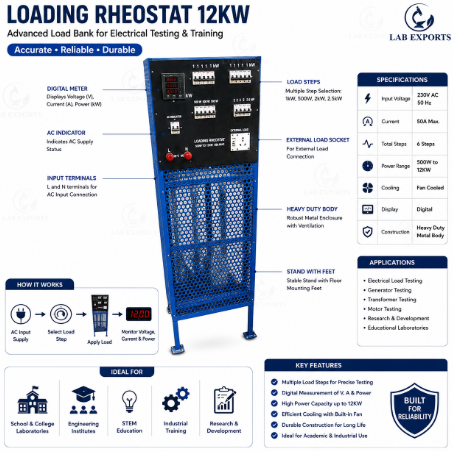
A resistive load bank reproduces an electrical load by converting the supplied electrical energy primarily into heat through resistance elements. It allows instructors, students and technicians to examine how a source performs when a known load is connected, without depending on unrelated operational equipment as the test load.

The Lab Exports Resistive Load Bank is intended for practical demonstrations, electrical machine experiments and controlled load-testing exercises. The rated voltage, current, power capacity, phase configuration, load steps, terminal arrangement, enclosure material and cooling method have not been supplied and must be confirmed before the product page is published or an order is placed.

Key Features

Resistive load simulation: Applies an electrical load based on resistance for laboratory testing and instructional work.

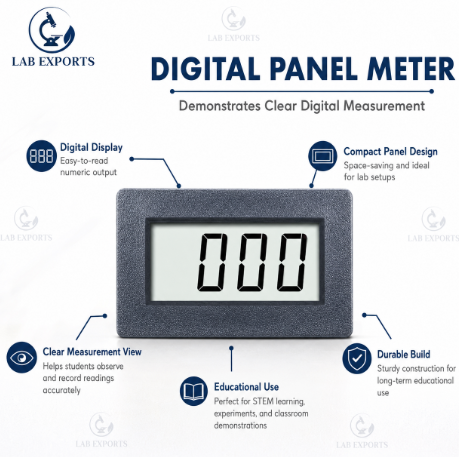
Practical measurement support: Enables users to observe voltage, current and power under connected-load conditions.

Training-focused operation: Supports demonstrations of basic loading principles in electrical and electronics laboratories.

Controlled experimentation: Provides a dedicated load device for repeatable circuit and source-performance exercises.

Broad educational relevance: Suitable for electrical engineering, electronics, power systems and vocational laboratory instruction.

Configurable requirement: Required power rating, voltage, phase and load-step arrangement can be specified during enquiry.

Bench or installation format: Physical configuration and mounting arrangement are available subject to confirmation.

Technical Specifications

Specification

Detail

Product name

Resistive Load Bank

Load type

Resistive

Applications and Uses

Demonstrating the effect of electrical loading on a power source

Studying voltage, current, resistance and power relationships

Performing supervised generator and power-supply loading exercises

Evaluating voltage regulation under different resistive loads

Supporting electrical machine and power-system laboratory experiments

Training students in safe load connection and measurement procedures

Providing a dedicated test load during equipment demonstrations

How to Use the Resistive Load Bank

Verify that the load bank voltage, current, power and phase ratings match the source being tested.

Place or install the unit in a dry, ventilated area with the power source switched off.

Inspect the terminals, cables, protective devices and earthing connection.

Connect the source to the designated input terminals according to the supplied wiring instructions.

Set the load controls to their minimum or disconnected position before energising the system.

Switch on the source and apply the resistive load gradually within the rated capacity.

Record the required voltage, current and power measurements.

Remove the load, switch off the source and allow the unit to cool before disconnecting it.

Safety note: A resistive load bank can generate substantial heat. It must be operated only within its confirmed electrical ratings, with adequate ventilation, proper earthing and supervision by a competent instructor or technician.

Care & Maintenance

Keep ventilation openings and resistance-element areas free from dust and obstruction.

Inspect cables, terminals, switches and protective components before use.

Allow the unit to cool completely before cleaning, handling or storage.

Store it in a dry location and arrange periodic electrical inspection by qualified personnel.

Why Choose Lab Exports?

Lab Exports manufactures and exports scientific instruments, educational laboratory equipment and practical training setups for institutional use. Its range includes equipment for physics, electrical, electronics and engineering laboratories. Buyers can specify project requirements such as voltage, capacity, phase configuration and required accessories during enquiry. Technical details should be reviewed and approved before production or dispatch.

Frequently Asked Questions

What is a Resistive Load Bank used for?

It is used to apply a resistive electrical load to a power source or circuit. This allows users to observe source performance and measure voltage, current and power under load.

How does a resistive load bank work?

Resistance elements draw current from the connected source and convert electrical energy primarily into heat. The resulting load can be used for testing and instructional measurements.

Can it be used for generator testing?

A suitably rated resistive load bank can be used for controlled generator-loading exercises. The generator output and the load bank voltage, phase, frequency and power ratings must match.

Is this load bank suitable for engineering colleges?

Yes. It can support supervised experiments in electrical engineering, power systems, electrical machines and vocational training laboratories.

What capacity is available?

The rated capacity has not been provided in the available product data. Buyers should specify the required power capacity, voltage, phase and load-step arrangement when requesting a quotation.

Does a resistive load bank become hot during operation?

Yes. Resistive loading converts electrical energy into heat. Adequate ventilation, safe clearance and cooling time are therefore essential.

Submit your required electrical ratings to Lab Exports or explore related physics laboratory equipment and laboratory equipment for institutional procurement.

Recommended product image ALT text: Resistive Load Bank for electrical engineering laboratory testing and training

   
Supply of Resistive Load Bank from to Finland, France, Tanzania, Thailand, Sri Lanka, Congo, Costa Rica, Ivory Coast, Croatia, Cuba, Cyprus, Czech Republic, Denmark, Djibouti, Dominica, Afghanistan, Albania, Algeria, Andorra, Angola, Antigua and Barbuda, Argentina, Armenia, Australia, Austria, Azerbaijan, Bahamas, Bahrain, Bangladesh, Barbados, United Arab Emirates (UAE, Dubai), United Kingdom (London), United States, Uruguay, Uzbekistan, Vanuatu, Belarus, Belgium, Belize, Benin, Bhutan, Bolivia, Bosnia and Herzegovina, Botswana, Brazil, Brunei, Bulgaria, Burkina Faso, Burma Myanmar, East Timor, Ecuador, Egypt, El Salvador, Equatorial Guinea, Eritrea, Estonia, Ethiopia (Addis Ababa), Fiji, Burundi, Cambodia, Cameroon, Canada, Cape Verde, Central African Republic, Chad, Chile, Colombia. Math Teaching Kit suppliers in Luxembourg, Macedonia, Madagascar, Malawi (Lilongwe), Malaysia (Kuala Lumpur), Maldives, Mali, Malta, Marshall Islands, Mauritania, Mexico, Micronesia, Moldova, Monaco, Mongolia, Montenegro, Morocco, Mozambique, Namibia, Comoros, Congo. Math Teaching Kit manufacturers in Dominican Republic, Gabon, Gambia, Georgia, Germany, Ghana, Greece, Grenada, Guatemala, Guinea, Guinea-Bissau, Guyana, Haiti, Honduras, Hungary, Iceland, Indonesia, Iran, Iraq, Niger, Nigeria (Abuja), Norway, Oman, Palau, Panama, Papua New Guinea, Paraguay, Peru, Philippines (Manila), Poland, Ireland, Israel, Italy, Jamaica, Japan, Jordan, Kazakhstan, Kenya (Nairobi), Kiribati, Korea, Kuwait, Kyrgyzstan, Laos, Latvia, Lebanon, Lesotho, Liberia, Liechtenstein, Lithuania, Mauritius, Nauru, Nepal, Netherlands, New Zealand, Nicaragua, Portugal, Qatar, Romania, Russia, Rwanda (Kigali). Math Teaching Kit exportets to Saint Kitts and Nevis, Saint Lucia, Saint Vincent and the Grenadines, Samoa, San Marino, Sao Tome and Principe, Saudi Arabia, Senegal, Serbia, Seychelles, Sierra Leone, Singapore, Slovakia, Slovenia, Solomon Islands, Somalia, South Africa, South Sudan, Spain, Sudan, Suriname, Swaziland, Sweden, Switzerland, Syria, Tajikistan, Togo, Tonga, Trinidad and Tobago, Tunisia, Turkey, Turkmenistan, Tuvalu, Uganda (Kampala), Ukraine, Venezuela, Vietnam, Yemen , Zambia (Lusaka), Zimbabwe

Office Address

Works:11/315, Lalita Park, Laxmi Nagar, Delhi, 110092

[email protected]

Follow Us