LDR Characteristics Apparatus
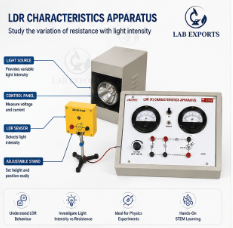
Product Code : SCL-EAE-11203
Quick answer: The LDR Characteristics Apparatus is used to study a light-dependent resistor (photoresistor). Students change the light falling on the LDR in steps, record the resistance, current or voltage, and plot the characteristic curve that shows resistance falling as illumination increases. It also introduces light-sensing and automatic lighting circuits. Lab Exports manufactures it in Delhi for schools, colleges and universities.
Specifications
| Parameter | Detail |
|---|---|
| Experiment | Study of light-dependent resistor (LDR) characteristics |
| Measured quantities | Resistance, voltage or current (per the configuration supplied) |
Light source, meter arrangement, operating voltage and ranges are not listed on this page; email [email protected] with the house code for the current model.
How the LDR experiment is done
An LDR is made of a semiconductor, such as cadmium sulphide, whose resistance drops when light falls on it, because the absorbed light frees more charge carriers. In darkness its resistance is high; in bright light it falls sharply. This makes the LDR a simple light sensor for street lights, alarms and exposure meters.
- Place the apparatus on a dry bench and identify the LDR, the light source, the controls and the measuring terminals.
- Connect the specified power supply and the measuring instruments.
- Set the light source to the first intensity or distance, switch on and record the reading.
- Change the illumination in steps and record the reading at each step.
- Calculate the resistance where needed and plot resistance against illumination.
The graph falls steeply at low light levels and flattens at high illumination. Placing the LDR in a voltage-divider circuit then shows how a change in light becomes a change in voltage that can switch a lamp or buzzer.
Key features
- Shows the response of an LDR to changing light levels
- Supports measurement of resistance, current or voltage in the LDR circuit
- Suits graph plotting and comparison of results between student groups
- Introduces photoresistors, light sensors and automatic lighting circuits
- Useful for teaching voltage-divider circuits with a sensor
- Suits teacher demonstrations and supervised student practicals
Documentation and supply
Most Lab Exports products carry a one-year manufacturer warranty.
Lab Exports manufactures the LDR characteristics apparatus at its works in Laxmi Nagar, Delhi, and supplies it to schools, colleges and universities in India and 60+ countries, handling the export documents for each shipment. More about the company is on the About Lab Exports page.
Related Electrical and Electronics products
- Galvanometer (SCL-EAE-11202)
- Digital Panel Meter (SCL-EAE-11204)
- Conversion of Galvanometer (SCL-EAE-11201)
- Good and Bad Conductor of Electricity (SCL-EAE-11200)
- Step Down Transformer (SCL-EAE-11207)
- Brass Wire (100 gm) (SCL-EAE-11209)
The full range is in the Electrical and Electronics section of the Physics Lab range.
Frequently asked questions
What happens to an LDR when light falls on it?
Its resistance decreases. More light frees more charge carriers in the semiconductor, so the LDR conducts better in bright light and has a high resistance in the dark.
What graph is plotted in the LDR experiment?
Resistance, or current, against light intensity or distance from the source. Resistance falls as illumination rises, steeply at first and then more slowly.
What is the price of the LDR characteristics apparatus?
Prices are not published on the website. Add the LDR characteristics apparatus to the Enquiry Cart with the Add To Cart button on this page, or email [email protected] with the house code SCL-EAE-11203 and the quantity, to receive a quotation.
Does Lab Exports manufacture the LDR characteristics apparatus?
Yes. Lab Exports manufactures the LDR characteristics apparatus at its works at 11/315, Lalita Park, Laxmi Nagar, Delhi 110092, under house code SCL-EAE-11203.
Request a quote
Email [email protected] with the house code SCL-EAE-11203 and the quantity, or add the LDR characteristics apparatus to the Enquiry Cart with the Add To Cart button on this page. Tender buyers can also see the Tenders and OEM page.