Good and Bad Conductor of Electricity
Product Code : SCL-EAE-11200
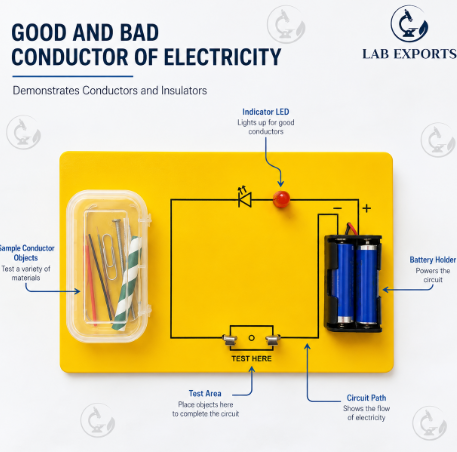
Quick answer: The Good and Bad Conductor of Electricity apparatus is a low-voltage test circuit for sorting materials into conductors and insulators. A sample is placed across the test contacts; if it conducts, the circuit closes and the indicator responds, and if it insulates, there is little or no response. Lab Exports manufactures it in Delhi for schools.
Specifications
| Item | Specification |
|---|---|
| Principle | Test material completes a low-voltage circuit; an indicator shows whether current flows |
| Purpose | Classifying materials as good conductors or insulators |
Indicator type, samples supplied, base and electrical rating are not listed on this page; email [email protected] with the house code for the current configuration.
How the conductor test is done
A material is a good conductor when it has many free charge carriers, as metals do, and a poor conductor or insulator when it has very few, as with plastic, rubber, glass, dry wood or paper. Placing each sample in the gap of a simple circuit turns this idea into a direct observation.
- Check the circuit by touching the two test contacts together; the indicator should respond.
- Place a sample firmly across the test contacts.
- Note whether the indicator responds fully, weakly or not at all.
- Repeat with each sample and record the results in a conductor and insulator table.
Metals such as copper, aluminium and iron make the indicator respond, while plastic, rubber, glass and dry wood do not. Graphite from a pencil is a useful extra sample because it is a non-metal that conducts.
Key features
- Direct comparison of conducting and insulating materials by observation
- Low-voltage circuit for supervised classroom use
- Demonstrates open and closed circuits with one set-up
- Suits teacher demonstration and small-group practical work
- Reusable across classes and school years
Documentation and supply
Most Lab Exports products carry a one-year manufacturer warranty.
Lab Exports manufactures the good and bad conductor apparatus at its works in Laxmi Nagar, Delhi, and supplies it to schools in India and 60+ countries, handling the export documents for each shipment. More about the company is on the About Lab Exports page.
Related Electrical and Electronics products
- Conversion of Galvanometer (SCL-EAE-11201)
- Galvanometer (SCL-EAE-11202)
- LDR Characteristics Apparatus (SCL-EAE-11203)
- Domestic Circuit Apparatus (SCL-EAE-11196)
- Digital Panel Meter (SCL-EAE-11204)
- Lamps in Series Kit (SCL-EAE-11195)
The full range is in the Electrical and Electronics section of the Physics Lab range.
Frequently asked questions
What does the good and bad conductor apparatus show?
It shows which materials let an electric current pass. Conductors complete the circuit and the indicator responds; insulators leave the circuit open.
Which materials are good conductors of electricity?
Metals such as copper, aluminium and iron, and also graphite, are good conductors. Plastic, rubber, glass, dry wood and paper are insulators.
What is the price of the good and bad conductor apparatus?
Prices are not published on the website. Add the good and bad conductor apparatus to the Enquiry Cart with the Add To Cart button on this page, or email [email protected] with the house code SCL-EAE-11200 and the quantity, to receive a quotation.
Does Lab Exports manufacture the good and bad conductor apparatus?
Yes. Lab Exports manufactures the good and bad conductor apparatus at its works at 11/315, Lalita Park, Laxmi Nagar, Delhi 110092, under house code SCL-EAE-11200.
Request a quote
Email [email protected] with the house code SCL-EAE-11200 and the quantity, or add the good and bad conductor apparatus to the Enquiry Cart with the Add To Cart button on this page. Tender buyers can also see the Tenders and OEM page.