Tuning Fork with Resonance
Product Code : SCL-PMP-11140
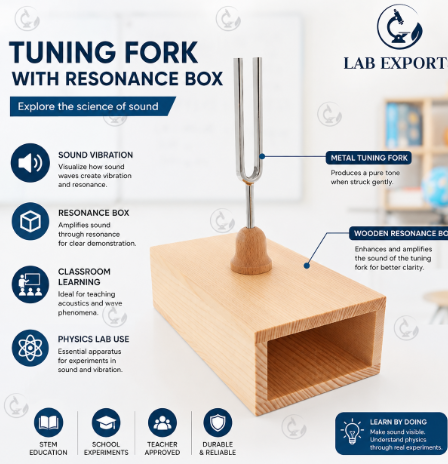
Quick answer: The tuning fork with resonance is a sound demonstration apparatus: a struck tuning fork vibrates at its natural frequency, and a matching resonating chamber reinforces the note so it is heard more loudly. It is used to teach vibration, frequency, pitch, natural frequency and resonance. Lab Exports manufactures it in Delhi for schools, colleges and universities.
Specifications
| Parameter | Detail |
|---|---|
| Pack format | Single sound demonstration apparatus |
| Principle | Mechanical vibration and acoustic resonance |
| Concepts taught | Sound, vibration, resonance, natural frequency, frequency, pitch and acoustic amplification |
| Operation | Manual; the fork is struck, no power needed |
Fork frequency and the form of the resonating chamber are confirmed with the quotation.
How the resonance experiment is done
Every object has natural frequencies at which it vibrates most readily. A tuning fork vibrates at one fixed frequency, but on its own it moves little air, so its note is faint. When the fork is coupled to a resonator whose natural frequency matches it, the air in the resonator vibrates strongly in step with the prongs. The energy is then passed to the surrounding air far more effectively, and the note is heard much louder. This is acoustic resonance.
- Place the apparatus on a clean, stable and level table and check that the fork and resonator are correctly positioned.
- Hold the fork by its stem, never by the prongs.
- Strike one prong gently with a soft striker or rubber pad.
- Listen to the note from the fork alone, then with the resonating arrangement, and compare the loudness.
- Touch the prongs to stop the sound before repeating.
The comparison shows that resonance does not change the pitch, which is set by the frequency of the fork, but greatly increases the loudness.
Key features
- Shows that a vibrating tuning fork produces sound waves.
- Resonating arrangement reinforces the note so resonance can be heard clearly.
- Supports lessons on natural frequency, frequency and pitch.
- Lets students compare the sound with and without resonant reinforcement.
- Manual operation, with no electrical supply needed.
- Pairs with Powell's wave apparatus in lessons on waves and sound.
Documentation and supply
Most Lab Exports products carry a one-year manufacturer warranty.
Lab Exports manufactures the tuning fork with resonance at its works in Laxmi Nagar, Delhi, and supplies it to schools, colleges and universities in India and 60+ countries, handling the export documents for each shipment. More about the company is on the About Lab Exports page.
Related Physics Miscellaneous Products products
- Drawing Board (SCL-PMP-11137)
- Resonance Apparatus (SCL-PMP-11143)
- Windmill Model (SCL-PMP-11148)
- Transverse and Longitudinal Wave Model (SCL-PMP-11121)
- Doppler Effect Kit (SCL-PMP-11117)
- Powell's Wave (SCL-PMP-11115)
The full range is in the Physics Miscellaneous Products section of the Physics Lab range.
Frequently asked questions
Why does the resonator make the tuning fork louder?
Its natural frequency matches the fork, so the air in it vibrates strongly in step with the prongs and passes the sound energy to the room more effectively. This is acoustic resonance.
Does resonance change the pitch of the tuning fork?
No. The pitch is set by the frequency of the fork; resonance increases only the loudness of the note.
What is the price of the tuning fork with resonance?
Prices are not published on the website. Add the tuning fork with resonance to the Enquiry Cart with the Add To Cart button on this page, or email [email protected] with the house code SCL-PMP-11140 and the quantity, to receive a quotation.
Does Lab Exports manufacture the tuning fork with resonance?
Yes. Lab Exports manufactures the tuning fork with resonance at its works at 11/315, Lalita Park, Laxmi Nagar, Delhi 110092, under house code SCL-PMP-11140.
Request a quote
Email [email protected] with the house code SCL-PMP-11140 and the quantity, or add the tuning fork with resonance to the Enquiry Cart with the Add To Cart button on this page. Tender buyers can also see the Tenders and OEM page.