Resonance Apparatus
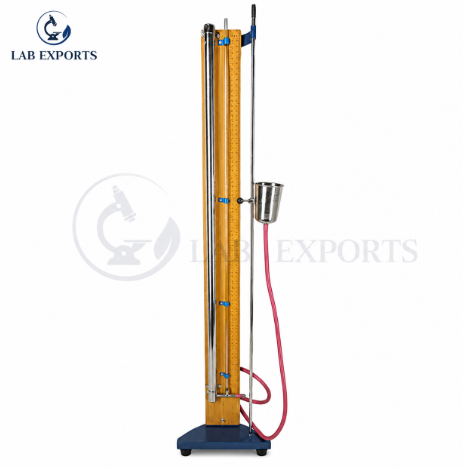
Product Code : SCL-PMP-11143
Quick answer: A resonance apparatus sets up acoustic resonance in an air column: when the column length matches the frequency of a sound source such as a tuning fork, the sound becomes noticeably louder. The resonance positions are used to study standing waves and to find the wavelength and speed of sound. Lab Exports manufactures it in Delhi for schools, colleges and universities.
Specifications
| Parameter | Detail |
|---|---|
| Principle | Acoustic resonance of an air column |
| Concepts | Resonance, standing waves, frequency, wavelength, natural frequency and sound propagation |
| Sound source | A suitable tuning fork or other specified source |
Tuning fork, striker, reservoir, scale, stand and other accessories are confirmed with the quotation and are not assumed to be included.
How the resonance experiment is done
A column of air closed at one end resonates when its effective length is an odd number of quarter wavelengths of the sound held over its open end. At the first resonance L1 + e = lambda/4 and at the second L2 + e = 3 lambda/4, where e is the end correction. Subtracting the two removes e, so lambda = 2(L2 - L1), and the speed of sound follows from v = f lambda, with f the frequency of the fork.
- Set the apparatus upright on a level bench and check that the length of the air column can be varied smoothly.
- Strike a tuning fork of known frequency and hold it over the open end of the column.
- Increase the length of the air column slowly from its shortest setting until the sound is loudest, and note this first resonance length.
- Continue to the second, longer position of maximum sound and note that length.
- Repeat each reading with a freshly struck fork and take the mean.
The difference between the two resonance lengths gives half a wavelength directly. Repeating with forks of other frequencies shows that the resonance length falls as frequency rises, while v stays constant.
Key features
- Direct observation of resonance in an air column.
- Helps explain standing waves and the link between wavelength, frequency and resonant length.
- Resonance positions support wavelength and speed-of-sound calculations.
- Works with a compatible tuning fork or other specified sound source.
- Simple principle: students locate the positions where the sound becomes noticeably stronger.
- Suited to supervised school, college and university physics practicals.
Documentation and supply
Most Lab Exports products carry a one-year manufacturer warranty.
Lab Exports manufactures the resonance apparatus at its works in Laxmi Nagar, Delhi, and supplies it to schools, colleges and universities in India and 60+ countries, handling the export documents for each shipment. More about the company is on the About Lab Exports page.
Related Physics Miscellaneous Products products
- Tuning Fork with Resonance (SCL-PMP-11140)
- Windmill Model (SCL-PMP-11148)
- Drawing Board (SCL-PMP-11137)
- Transverse and Longitudinal Wave Model (SCL-PMP-11121)
- Doppler Effect Kit (SCL-PMP-11117)
- Powell's Wave (SCL-PMP-11115)
The full range is in the Physics Miscellaneous Products section of the Physics Lab range.
Frequently asked questions
How is the speed of sound found with a resonance apparatus?
Measure the first and second resonance lengths, L1 and L2, for a fork of frequency f. Then lambda = 2(L2 - L1) and the speed of sound is v = f lambda.
Is a tuning fork included with the resonance apparatus?
Inclusion of a tuning fork and other accessories is confirmed with the quotation, so state the fork frequencies required when sending an enquiry.
What is the price of the resonance apparatus?
Prices are not published on the website. Add the resonance apparatus to the Enquiry Cart with the Add To Cart button on this page, or email [email protected] with the house code SCL-PMP-11143 and the quantity, to receive a quotation.
Does Lab Exports manufacture the resonance apparatus?
Yes. Lab Exports manufactures the resonance apparatus at its works at 11/315, Lalita Park, Laxmi Nagar, Delhi 110092, under house code SCL-PMP-11143.
Request a quote
Email [email protected] with the house code SCL-PMP-11143 and the quantity, or add the resonance apparatus to the Enquiry Cart with the Add To Cart button on this page. Tender buyers can also see the Tenders and OEM page.