Melde’s Apparatus
Product Code : SCL-PMP-11206
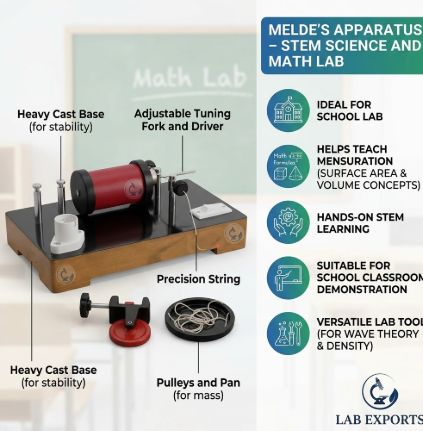
Quick answer: Melde's apparatus sets up standing waves on a stretched string driven at a suitable frequency, so nodes and antinodes can be seen and counted. It is used to study how frequency, wavelength, string tension and vibrating length are related, and to find an unknown frequency. Lab Exports manufactures it in Delhi for schools, colleges and universities.
Specifications
| Parameter | Detail |
|---|---|
| Experiment type | Standing-wave and vibrating-string experiment |
| Primary observations | Nodes, antinodes and stationary-wave patterns |
| Parameters studied | Frequency, wavelength, string tension and vibrating length |
Vibration source, mechanical construction, dimensions and accessories depend on the supplied model and are confirmed with the quotation.
How Melde's experiment is done
When a stretched string is driven at one end, waves travel to the fixed end and are reflected back. At certain combinations of tension and length the outgoing and reflected waves combine into a stationary wave, with nodes that stay still and antinodes that swing widely, and the string divides into a whole number of loops. For p loops over a vibrating length L, the frequency of vibration is f = (p / 2L) x sqrt(T / m), where T is the tension and m the mass per unit length of the string.
- Set the apparatus on a stable bench and fix the string as described for the supplied configuration.
- Apply tension with the specified tensioning or weight arrangement.
- Start the vibration source under the operating conditions given in the manual.
- Adjust the tension or vibrating length until a steady pattern of well-defined loops appears.
- Count the loops, measure the vibrating length and record the tension; repeat for other settings.
A graph of tension T against the square of the loop length, (L/p)^2, is a straight line of slope 4 m f^2, from which the frequency is found. Students also see directly that raising the tension lengthens each loop, so fewer loops fit on the string.
Key features
- Demonstrates stationary waves on a stretched string.
- Makes nodes and antinodes directly observable.
- Supports investigation of frequency, wavelength, tension and vibrating length.
- Allows repeated measurements under different experimental conditions.
- Suitable for classroom demonstrations and supervised practicals on oscillations, resonance and transverse waves.
Documentation and supply
Installation instructions and a manual are supplied with the apparatus. Most Lab Exports products carry a one-year manufacturer warranty.
Lab Exports manufactures the Melde's apparatus at its works in Laxmi Nagar, Delhi, and supplies it to schools, colleges and universities in India and 60+ countries, handling the export documents for each shipment. More about the company is on the About Lab Exports page.
Related Physics Miscellaneous Products products
- PM Shri Science Kit (SCL-PMP-11197)
- Biogas Plant Working Model (SCL-PMP-11217)
- Analytical Weight Box Brass (SCL-PMP-11190)
- Reflection of Sound Apparatus (SCL-PMP-11222)
- Globe 12" (SCL-PMP-11238)
- Sonometer Apparatus (SCL-HM-11239)
The full range is in the Physics Miscellaneous Products section of the Physics Lab range.
Frequently asked questions
What is Melde's apparatus used for?
For demonstrating standing waves on a stretched string and for studying the relation between frequency, wavelength, tension and vibrating length.
What can students observe during Melde's experiment?
Nodes, where the string stays still, and antinodes, where it vibrates most, forming a whole number of loops whose count changes with the tension.
What is the price of the Melde's apparatus?
Prices are not published on the website. Add the Melde's apparatus to the Enquiry Cart with the Add To Cart button on this page, or email [email protected] with the house code SCL-PMP-11206 and the quantity, to receive a quotation.
Does Lab Exports manufacture the Melde's apparatus?
Yes. Lab Exports manufactures the Melde's apparatus at its works at 11/315, Lalita Park, Laxmi Nagar, Delhi 110092, under house code SCL-PMP-11206.
Request a quote
Email [email protected] with the house code SCL-PMP-11206 and the quantity, or add the Melde's apparatus to the Enquiry Cart with the Add To Cart button on this page. Tender buyers can also see the Tenders and OEM page.