Powell's Wave

Product Code : SCL-PMP-11115
This hand-cranked wave machine models a travelling transverse wave. A shaft carries eccentric cams set progressively further round, and a row of vertical rods rests on them. As the crank turns, each rod rises and falls a little after its neighbour, so crests and troughs move along the row. No power supply is needed.
Specifications of the Powell wave machine
| Component | Specification |
|---|---|
| Wave shown | Transverse wave |
| Mechanism | Vertical rods resting on a rotating shaft with progressively offset eccentric cams |
| Drive | Manual hand crank, attached |
| Rod tops | High-visibility caps for following crests and troughs |
| Power | None; fully mechanical |
| Supplied | Fully assembled, with an instructional guide and lesson plan suggestions |
| House code | SCL-PMP-11115 |
| Manufacturer | Lab Exports, Delhi |
Cam timing and frequency on the rod model
Every rod moves with the same amplitude and period. Only its timing differs, because its cam sits a little further round the shaft. That timing difference is a phase difference, and it is what turns separate up-and-down motions into a wave that seems to travel.
- Phase along the row. Turn the crank very slowly. Starting from one capped rod, students follow the row in the direction the crests travel. Each rod reaches its highest point a little later than the one before. The lag builds up until one rod moves exactly in step with the first, and the gap between those two rods is one wavelength.
- Slow crank, fast crank. One student counts the crests that pass a chosen rod while a partner times a set interval on an analog stop clock. Repeat with the crank turned faster. More crests pass the rod each second, so the frequency is higher.
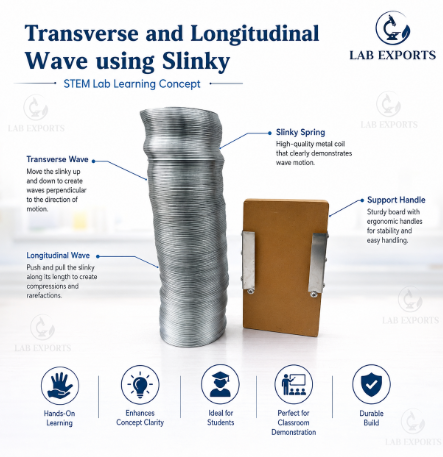
- What passes the motion on. Two students stretch a slinky spring along a long bench and send a sideways pulse. Compare it with the rods. On the slinky each coil pulls on the next; on the model the cam shaft sets the timing of every rod.
Frequently Asked Questions
How does Powell's wave apparatus work?
The crank turns a shaft carrying eccentric cams. Each vertical rod rests on its own cam, and each cam is set a little further round than the last. The rods therefore rise and fall in sequence, and the pattern of their tops moves along as a progressive transverse wave.
Does this wave machine also show longitudinal waves?
No. This model is listed for transverse waves only: its rods move up and down. Some wave machines add sliding rods that show compressions and rarefactions, but no such feature is listed for this apparatus. A slinky spring is a simple way to show a longitudinal wave beside it.
Are progressive waves always transverse?
No. A progressive wave is any wave that carries energy from place to place, and it can be transverse or longitudinal. Sound in air is a progressive longitudinal wave. The cam model shows the transverse kind, where the moving parts vibrate across the direction of travel.
How can you tell that a wave is transverse?
Compare the direction in which the particles vibrate with the direction in which the wave moves. If they are at right angles, the wave is transverse. On this machine each rod only moves vertically, while the crests move horizontally along the row.
Other apparatus for wave lessons
More apparatus is in the Physics Miscellaneous Products section of the Physics Lab range.
To enquire, email [email protected] with the house code SCL-PMP-11115 and the quantity, or use the Add To Cart button on this page.
Last updated: 28 November 2026