Transverse and Longitudinal Wave Model
Product Code : SCL-PMP-11121
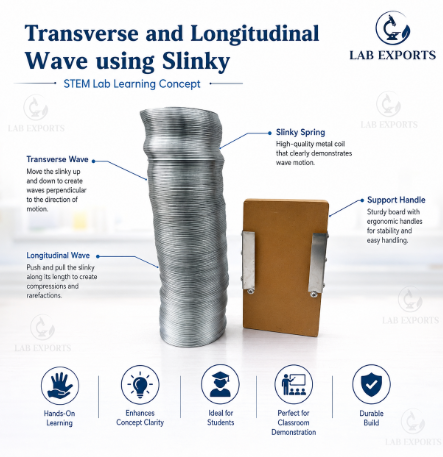
Quick answer: The transverse and longitudinal wave model is a single demonstration model that shows the two basic forms of mechanical wave. Students compare particle displacement at right angles to the direction of travel, with crests and troughs, against displacement along it, with compressions and rarefactions. Lab Exports manufactures it in Delhi for schools, colleges and universities.
Specifications
| Parameter | Detail |
|---|---|
| Pack format | Single demonstration model |
| Wave types demonstrated | Transverse and longitudinal |
| Concepts shown | Particle displacement, wave propagation, crests, troughs, compressions and rarefactions |
Dimensions and construction are confirmed with the quotation.
How the model is used in teaching
A mechanical wave carries energy through a medium while each particle only oscillates about its rest position. In a transverse wave, such as a wave on a string, the particles move at right angles to the direction of travel and form crests and troughs. In a longitudinal wave, such as sound in air, they move back and forth along the direction of travel, forming compressions where particles crowd together and rarefactions where they spread apart.
Wavelength is the distance between two neighbouring crests, or between two neighbouring compressions, and the same relation v = f lambda applies to both kinds of wave.
- Introduce the idea of a medium whose particles oscillate while the wave moves on.
- Show the transverse wave first and have students label a crest, a trough and one wavelength.
- Show the longitudinal wave and have them mark a compression, a rarefaction and one wavelength.
- Ask students to state, for each wave, whether particle motion is perpendicular or parallel to the direction of travel.
Key features
- Demonstrates both transverse and longitudinal wave motion in one model.
- Lets students compare perpendicular and parallel particle displacement.
- Supports explanation of crests, troughs and wavelength for transverse waves.
- Supports explanation of compressions and rarefactions for longitudinal waves.
- Suited to teacher demonstrations and supervised student activities, and reusable lesson after lesson.
Documentation and supply
Most Lab Exports products carry a one-year manufacturer warranty.
Lab Exports manufactures the transverse and longitudinal wave model at its works in Laxmi Nagar, Delhi, and supplies it to schools, colleges and universities in India and 60+ countries, handling the export documents for each shipment. More about the company is on the About Lab Exports page.
Related Physics Miscellaneous Products products
- Doppler Effect Kit (SCL-PMP-11117)
- Powell's Wave (SCL-PMP-11115)
- CBSE Physics Lab Package (SCL-PMP-11105)
- Drawing Board (SCL-PMP-11137)
- Tuning Fork with Resonance (SCL-PMP-11140)
- Resonance Apparatus (SCL-PMP-11143)
The full range is in the Physics Miscellaneous Products section of the Physics Lab range.
Frequently asked questions
What is the difference between a transverse and a longitudinal wave?
In a transverse wave the particles move at right angles to the direction of travel; in a longitudinal wave they move parallel to it. The model shows both so the difference can be seen directly.
Which concepts can be taught with the transverse and longitudinal wave model?
Particle displacement, wave propagation, crests and troughs, compressions and rarefactions, and wavelength.
What is the price of the transverse and longitudinal wave model?
Prices are not published on the website. Add the transverse and longitudinal wave model to the Enquiry Cart with the Add To Cart button on this page, or email [email protected] with the house code SCL-PMP-11121 and the quantity, to receive a quotation.
Does Lab Exports manufacture the transverse and longitudinal wave model?
Yes. Lab Exports manufactures the transverse and longitudinal wave model at its works at 11/315, Lalita Park, Laxmi Nagar, Delhi 110092, under house code SCL-PMP-11121.
Request a quote
Email [email protected] with the house code SCL-PMP-11121 and the quantity, or add the transverse and longitudinal wave model to the Enquiry Cart with the Add To Cart button on this page. Tender buyers can also see the Tenders and OEM page.