Discrete Component Trainer
Product Code : SCL-EAE-11160
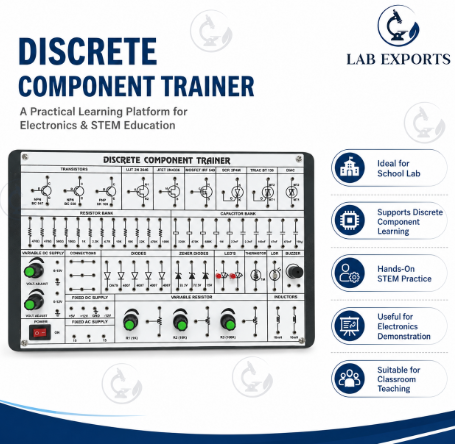
Quick answer: The Discrete Component Trainer is a bench kit on which students wire resistors, capacitors, inductors, diodes and transistors on a solderless breadboard and measure how they behave. It has a built-in regulated DC supply, onboard voltmeter and ammeter, and banks of potentiometers and fixed resistors, and comes with a starter pack of components. Lab Exports manufactures it in Delhi for colleges, universities and technical institutes.
Specifications
| Section | Specification |
|---|---|
| Breadboard | Central solderless breadboard for through-hole components |
| Power supply | Built-in regulated variable DC supply, mains operated |
| Meters | Onboard voltmeter and ammeter |
| Component banks | Potentiometers and standard fixed resistors |
| Connections | Stackable patch cords and standard jumper wires |
| Protection | Short-circuit and overload protection |
Experiments on the discrete component trainer
Before students meet integrated circuits, they need to understand the individual components those circuits are made from. On this trainer each component sits on the breadboard where it can be seen, measured and replaced, and the onboard meters show at once how voltage and current respond when a connection or a value is changed.
- With the power switch off, insert the components on the breadboard following the circuit diagram.
- Wire the circuit with hookup wires and connect it to the variable DC supply terminals.
- Connect the onboard voltmeter in parallel and the ammeter in series with the component under test.
- Switch on, raise the supply in steps and record the readings.
- Plot the characteristic curve and compare it with theory.
Standard practicals include forward and reverse V-I characteristics of PN junction and Zener diodes; transistor circuits in common base, common emitter and common collector configurations; half-wave, full-wave and bridge rectifiers showing AC to DC conversion; and passive low-pass, high-pass and band-pass RC and RL filters. This groundwork prepares students for op-amp and IC trainers later in the course.
Key features
- Central solderless breadboard for quick insertion of through-hole components.
- Built-in regulated DC supply for powering individual component circuits.
- Onboard voltmeter and ammeter for real-time readings.
- Onboard banks of potentiometers and fixed resistors.
- Short-circuit and overload protection against wiring errors.
What is included
- Discrete component trainer board
- Set of single-strand hookup wires and patch cords
- Starter pack of resistors, capacitors, diodes and transistors
- Laboratory experiment manual
Documentation and supply
A laboratory experiment manual is supplied with the trainer. Most Lab Exports products carry a one-year manufacturer warranty.
Lab Exports manufactures the discrete component trainer at its works in Laxmi Nagar, Delhi, and supplies it to colleges, universities and technical institutes in India and 60+ countries, handling the export documents for each shipment. More about the company is on the About Lab Exports page.
Related Electrical and Electronics products
- Digital IC Trainer (SCL-EAE-11159)
- Digital IC Trainer with Display (SCL-EAE-11161)
- Operational Amplifier Trainer (SCL-EAE-11158)
- Electronic Leclanche Cell (SCL-EAE-11162)
- Electronic Daniel Cell (SCL-EAE-11163)
- Battery Eliminator (SCL-EAE-11164)
The full range is in the Electrical and Electronics section of the Physics Lab range.
Frequently asked questions
What experiments can be done on the discrete component trainer?
Diode and Zener diode characteristics, transistor CB, CE and CC circuits, half-wave, full-wave and bridge rectifiers, and RC and RL filter circuits.
Are components supplied with the discrete component trainer?
Yes. A starter pack of resistors, capacitors, diodes and transistors is included, along with hookup wires, patch cords and an experiment manual.
What is the price of the discrete component trainer?
Prices are not published on the website. Add the discrete component trainer to the Enquiry Cart with the Add To Cart button on this page, or email [email protected] with the house code SCL-EAE-11160 and the quantity, to receive a quotation.
Does Lab Exports manufacture the discrete component trainer?
Yes. Lab Exports manufactures the discrete component trainer at its works at 11/315, Lalita Park, Laxmi Nagar, Delhi 110092, under house code SCL-EAE-11160.
Request a quote
Email [email protected] with the house code SCL-EAE-11160 and the quantity, or add the discrete component trainer to the Enquiry Cart with the Add To Cart button on this page. Tender buyers can also see the Tenders and OEM page.