Inductive Load
Product Code : SCL-EAE-11305
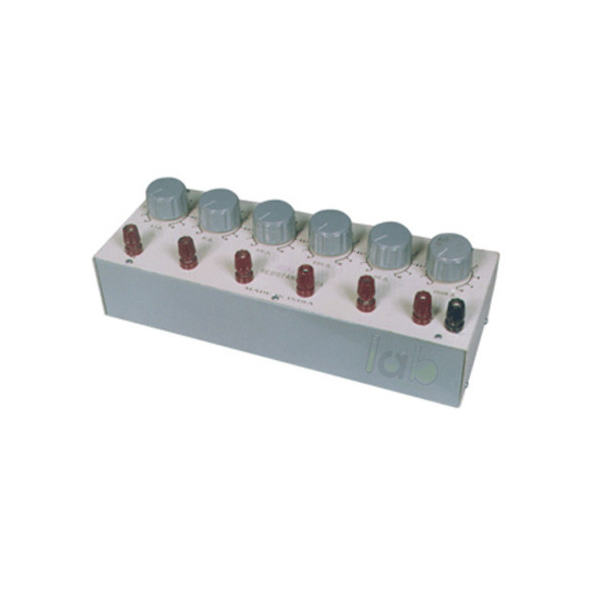
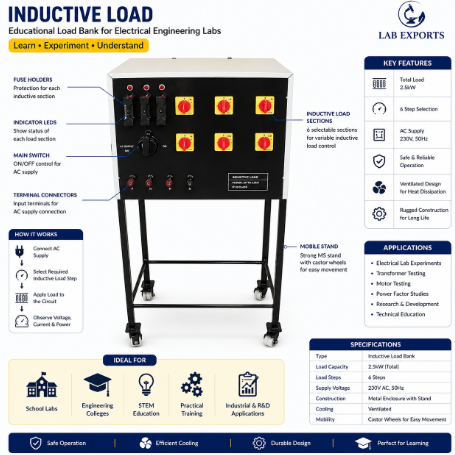
Quick answer: The Inductive Load is an AC inductive or reactive loading unit. Because an inductor stores energy in its magnetic field, the current it draws lags the applied voltage, so students can measure phase angle, active, reactive and apparent power and lagging power factor, and test alternators and transformers under inductive load. Lab Exports manufactures it in Delhi for engineering colleges, polytechnics and technical institutes.
Specifications
| Parameter | Detail |
|---|---|
| Equipment type | AC inductive or reactive loading unit |
| Load characteristic | Inductive, lagging current |
| Parts | Inductive elements or reactor assembly, load-selection or adjustment controls where applicable, input and output terminals |
Voltage, current, frequency, phase, inductance and reactive-power rating are confirmed in the quotation.
How the inductive load is used
In an ideal inductor the current lags the voltage by 90 degrees; a practical coil also has some resistance, so the lag is somewhat less. The angle of lag, phi, links the three powers of an AC circuit through the power triangle: active power P = V I cos phi in watts, reactive power Q = V I sin phi in VAR, and apparent power S = V I in VA, with S^2 = P^2 + Q^2.
Connecting the inductive load to an AC supply with a voltmeter, ammeter and wattmeter lets students measure V, I and P directly, calculate the power factor as cos phi = P / (V I), and then work out Q. Repeating the test with a resistive and a capacitive load shows the contrast between current in phase with the voltage, current that lags it and current that leads it.
- Check the rated voltage, current, frequency and phase configuration against the supply.
- Set the load control to its minimum-load position.
- Isolate the supply and connect the load through the voltmeter, ammeter and wattmeter.
- Switch on, increase the load in stages and record V, I and P at each stage.
Key features
- Introduces a controlled lagging load into a compatible AC circuit
- Shows the effect of inductance on phase angle and power factor
- Supports measurement of active, reactive and apparent power
- Load varied in steps or continuously, according to the supplied design
- Terminals for meters, trainers and electrical machines
- For supervised electrical engineering and power-system experiments
Documentation and supply
Most Lab Exports products carry a one-year manufacturer warranty.
Lab Exports manufactures the inductive load at its works in Laxmi Nagar, Delhi, and supplies it to engineering colleges, polytechnics and technical institutes in India and 60+ countries, handling the export documents for each shipment. More about the company is on the About Lab Exports page.
Related Electrical and Electronics products
- Lamp Load 2.5KW (SCL-EAE-11304)
- Loading Inductor 2.4KVAR (SCL-EAE-11306)
- Loading Rheostat 12KW (SCL-EAE-11303)
- Loading Capacitor 1.2KVAR Bank (SCL-EAE-11307)
- Resistive Load Bank (SCL-EAE-11302)
- Loading Inductor 1.2KVAR Bank (SCL-EAE-11308)
The full range is in the Electrical and Electronics section of the Physics Lab range.
Frequently asked questions
Why does current lag voltage in an inductive load?
An inductor opposes changes in current by storing energy in its magnetic field. The current therefore reaches its peak after the voltage, so it lags; in a pure inductance the lag is 90 degrees.
How is power factor measured with the inductive load?
Measure voltage, current and active power with a voltmeter, ammeter and wattmeter. Power factor = P / (V x I), which equals cos phi for a sinusoidal supply.
Request a quote
Email [email protected] with the house code SCL-EAE-11305 and the quantity, or add the inductive load to the Enquiry Cart with the Add To Cart button on this page. Tender buyers can also see the Tenders and OEM page.