Potentiometer Apparatus Manufacturer,Supplier and Exporter in India

Potentiometer Apparatus
Product Code : SCL-EAE-11258

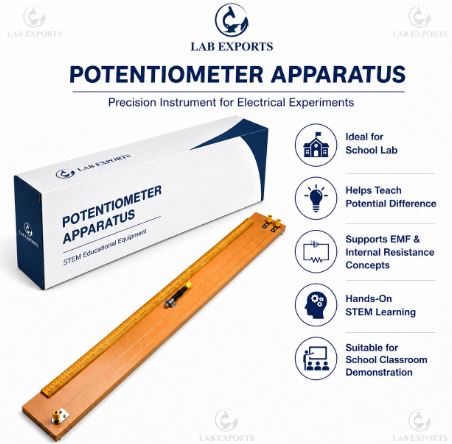
The Potentiometer Apparatus provides a practical platform for studying how potential difference varies along a uniform resistance wire. During an experiment, the user locates a balance point at which the detector shows no deflection. The corresponding balance length can then be used for comparison or calculation.

This educational apparatus supports the teaching of current electricity without relying only on theoretical circuit diagrams. Its laboratory format allows learners to assemble a working circuit, adjust the contact point and record observations. Exact construction materials, wire length, scale range and supplied accessories should be confirmed for the selected model before publication or purchase.

Key Features

Demonstrates the null method: Enables students to identify a balance point without taking a direct voltage reading at that point.

Supports EMF comparison: Suitable for comparing the electromotive forces of two cells under controlled laboratory conditions.

Explains potential gradient: Helps learners relate potential difference to the length of resistance wire used.

Encourages hands-on circuit work: Allows students to practise circuit assembly, contact adjustment and observation recording.

Suitable for guided practicals: Designed for instructor-led demonstrations and supervised student experiments.

Reusable teaching apparatus: Can support repeated physics practical sessions when handled and stored correctly.

Clear educational purpose: Connects the concepts of EMF, balance length, current and internal resistance in one experiment platform.

Technical Specifications

Specification

Detail

Product name

Potentiometer Apparatus

Brand

Lab Exports

Product category

Physics Laboratory Equipment / Electrical and Electronics

Primary function

EMF comparison and null-deflection experiments

Experimental principle

Potential-gradient and balance-length method

Applications and Uses

Comparing the EMF of two electrical cells

Determining the internal resistance of a cell

Studying the relationship between balance length and potential difference

Explaining the principle of potential gradient

Demonstrating the null-deflection measurement method

Conducting current-electricity practicals in physics laboratories

Supporting teacher demonstrations and student laboratory assessments

How to Use the Potentiometer Apparatus

Place the apparatus on a stable, dry laboratory bench and inspect the resistance wire and terminals.

Connect the potentiometer wire to the primary circuit through a suitable low-voltage source, key and current-control device.

Connect the test cell and sensitive detector in the secondary circuit according to the approved experiment diagram.

Close the primary circuit and move the contact gently along the wire.

Locate the point at which the detector indicates zero deflection.

Measure the balance length and repeat the procedure for the second cell or required circuit condition.

Record the observations and complete the calculation specified in the laboratory procedure.

Safety note: Use only the voltage and current specified for the supplied model. Avoid prolonged current flow, short circuits and excessive pressure on the resistance wire.

Care and Maintenance

Disconnect the power source before cleaning or storing the apparatus.

Keep the resistance wire straight, clean and free from corrosion.

Move the contact gently to avoid scratching, stretching or breaking the wire.

Store the apparatus in a dry, dust-free cabinet with terminals protected.

Why Choose Lab Exports?

Lab Exports manufactures and exports scientific laboratory instruments, educational experiment setups and STEM teaching equipment for institutional use. The Potentiometer Apparatus fits within the company’s range of physics laboratory equipment for practical science education.

Buyers can also review the related electrical and electronics laboratory equipment range or explore the broader laboratory equipment collection . Model-specific construction, accessories, packing and operating details should be confirmed during quotation.

Frequently Asked Questions

What is a Potentiometer Apparatus used for?

It is used to compare the EMF of electrical cells and to study potential difference through the null-deflection and balance-length method.

How does a laboratory potentiometer find the balance point?

The contact is moved along the resistance wire until the connected detector shows zero deflection. This position is called the balance or null point.

Can the apparatus determine the internal resistance of a cell?

Yes. It can support an internal-resistance experiment when connected with the required cell, resistance and detector circuit.

Is the Potentiometer Apparatus suitable for schools?

Yes. It is suitable for supervised senior-school and college physics practicals involving current electricity and EMF comparison.

Does the apparatus measure voltage directly?

The educational potentiometer uses a comparison or null method. The unknown value is established from the balance condition rather than from a conventional direct-reading voltmeter display.

Are the galvanometer and connecting accessories included?

The included components depend on the selected supply configuration. Buyers should confirm the complete accessory list before ordering.

Request the confirmed specification sheet, accessory list and export quotation through the Lab Exports enquiry page, or browse the related electrical and electronics laboratory range.

   
Supply of Potentiometer Apparatus from to Finland, France, Tanzania, Thailand, Sri Lanka, Congo, Costa Rica, Ivory Coast, Croatia, Cuba, Cyprus, Czech Republic, Denmark, Djibouti, Dominica, Afghanistan, Albania, Algeria, Andorra, Angola, Antigua and Barbuda, Argentina, Armenia, Australia, Austria, Azerbaijan, Bahamas, Bahrain, Bangladesh, Barbados, United Arab Emirates (UAE, Dubai), United Kingdom (London), United States, Uruguay, Uzbekistan, Vanuatu, Belarus, Belgium, Belize, Benin, Bhutan, Bolivia, Bosnia and Herzegovina, Botswana, Brazil, Brunei, Bulgaria, Burkina Faso, Burma Myanmar, East Timor, Ecuador, Egypt, El Salvador, Equatorial Guinea, Eritrea, Estonia, Ethiopia (Addis Ababa), Fiji, Burundi, Cambodia, Cameroon, Canada, Cape Verde, Central African Republic, Chad, Chile, Colombia. Math Teaching Kit suppliers in Luxembourg, Macedonia, Madagascar, Malawi (Lilongwe), Malaysia (Kuala Lumpur), Maldives, Mali, Malta, Marshall Islands, Mauritania, Mexico, Micronesia, Moldova, Monaco, Mongolia, Montenegro, Morocco, Mozambique, Namibia, Comoros, Congo. Math Teaching Kit manufacturers in Dominican Republic, Gabon, Gambia, Georgia, Germany, Ghana, Greece, Grenada, Guatemala, Guinea, Guinea-Bissau, Guyana, Haiti, Honduras, Hungary, Iceland, Indonesia, Iran, Iraq, Niger, Nigeria (Abuja), Norway, Oman, Palau, Panama, Papua New Guinea, Paraguay, Peru, Philippines (Manila), Poland, Ireland, Israel, Italy, Jamaica, Japan, Jordan, Kazakhstan, Kenya (Nairobi), Kiribati, Korea, Kuwait, Kyrgyzstan, Laos, Latvia, Lebanon, Lesotho, Liberia, Liechtenstein, Lithuania, Mauritius, Nauru, Nepal, Netherlands, New Zealand, Nicaragua, Portugal, Qatar, Romania, Russia, Rwanda (Kigali). Math Teaching Kit exportets to Saint Kitts and Nevis, Saint Lucia, Saint Vincent and the Grenadines, Samoa, San Marino, Sao Tome and Principe, Saudi Arabia, Senegal, Serbia, Seychelles, Sierra Leone, Singapore, Slovakia, Slovenia, Solomon Islands, Somalia, South Africa, South Sudan, Spain, Sudan, Suriname, Swaziland, Sweden, Switzerland, Syria, Tajikistan, Togo, Tonga, Trinidad and Tobago, Tunisia, Turkey, Turkmenistan, Tuvalu, Uganda (Kampala), Ukraine, Venezuela, Vietnam, Yemen , Zambia (Lusaka), Zimbabwe

Office Address

Works:11/315, Lalita Park, Laxmi Nagar, Delhi, 110092

[email protected]

Follow Us