Ohms Law Apparatus (with meters)

Product Code : SCL-EAE-11336
Quick answer: The Ohms Law Apparatus (with meters) is a practical set for studying and verifying Ohm's law. Its integrated meters show the voltage across and current through a conductor as the supply or circuit resistance is changed, so students can plot a V-I graph and calculate resistance. Lab Exports manufactures it in Delhi for schools, colleges and universities.
Specifications
| Parameter | Detail |
|---|---|
| Primary experiment | Study and verification of Ohm's law |
| Measured parameters | Voltage and current |
| Meter arrangement | Meters integrated for circuit measurements |
| Result | Resistance from R = V/I and the V-I graph |
| Brand | Lab Exports |
How the Ohm's law experiment is done
The experiment tests whether the potential difference across a conductor rises in proportion to the current through it. For a metallic conductor kept at a steady temperature the ratio V/I stays constant, and that constant is the resistance R, measured in ohms.
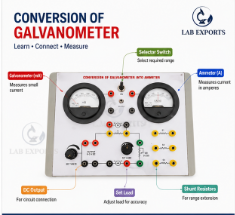
Because the meters are part of the apparatus, the class does not have to assemble a separate voltmeter and ammeter for every group. Teachers can use the fixed layout to show the correct way to connect measuring instruments: the ammeter in series with the load and the voltmeter in parallel across it.
- Keep the power off and turn the adjustable controls to their minimum settings.
- Connect the circuit according to the diagram, with the ammeter in series and the voltmeter across the load.
- Switch on and change the supply or the circuit resistance in small steps.
- Record the voltmeter and ammeter readings at each step in a table.
- Plot V against I and calculate R from the gradient and from individual readings.
Key features
- Designed to study and verify Ohm's law
- Integrated meters for voltage and current measurement
- Paired readings can be recorded for V-I graph plotting
- Resistance calculated with R = V/I
- Shows series ammeter and parallel voltmeter connection in one layout
Documentation and supply
Most Lab Exports products carry a one-year manufacturer warranty.
Lab Exports manufactures the Ohms Law Apparatus (with meters) at its works in Laxmi Nagar, Delhi, and supplies it to schools, colleges and universities in India and 60+ countries, handling the export documents for each shipment. More about the company is on the About Lab Exports page.
Related Electrical and Electronics products
- Digital Ohms Law Apparatus (SCL-EAE-11335)
- Ohms Law Apparatus (SCL-EAE-11337)
- Battery Eliminator AC/DC (SCL-EAE-11334)
- Ohm Meter Shunt Type (SCL-EAE-11338)
- Battery Eliminator 2-12V 2A (SCL-EAE-11333)
- Battery Eliminator (Socket) (SCL-EAE-11332)
The full range is in the Electrical and Electronics section of the Physics Lab range.
Frequently asked questions
What is the ohms law apparatus with meters used for?
To verify that the current through a conductor is proportional to the voltage across it, and to calculate its resistance from the readings.
How should the meters be connected in the Ohm's law experiment?
The ammeter is placed in series with the load to measure current, and the voltmeter in parallel across the load to measure potential difference.
What is the price of the Ohms Law Apparatus (with meters)?
Prices are not published on the website. Add the Ohms Law Apparatus (with meters) to the Enquiry Cart with the Add To Cart button on this page, or email [email protected] with the house code SCL-EAE-11336 and the quantity, to receive a quotation.
Does Lab Exports manufacture the Ohms Law Apparatus (with meters)?
Yes. Lab Exports manufactures the Ohms Law Apparatus (with meters) at its works at 11/315, Lalita Park, Laxmi Nagar, Delhi 110092, under house code SCL-EAE-11336.
Request a quote
Email [email protected] with the house code SCL-EAE-11336 and the quantity, or add the Ohms Law Apparatus (with meters) to the Enquiry Cart with the Add To Cart button on this page. Tender buyers can also see the Tenders and OEM page.