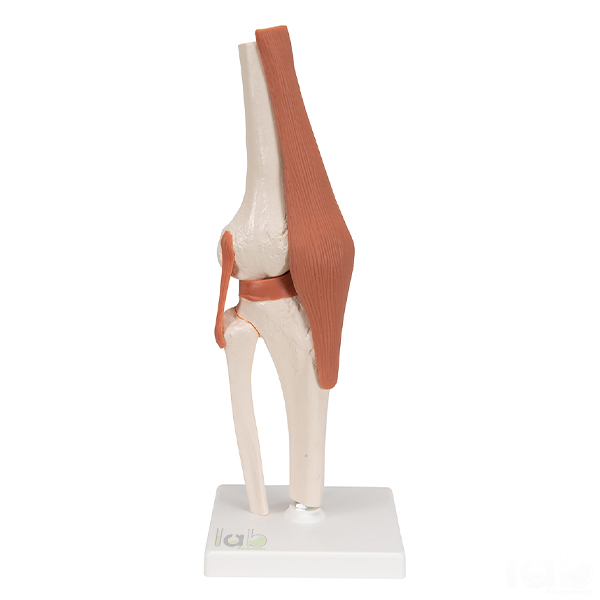
Knee Joint Model

Product Code : SCL-SBAJM-11370
Quick answer: The Knee Joint Model presents the human knee at life size, supplied on a stand and fitted with flexible artificial ligaments. It is used to teach how the knee is organised and how its ligaments are arranged around the joint, and can be viewed from every angle. Lab Exports manufactures it in Delhi for schools, colleges and universities.
Specifications
| Parameter | Details |
|---|---|
| Scale | Life size |
| Ligaments | Flexible artificial ligaments |
| Mounting | Supplied on a stand |
Material, dimensions and weight are confirmed with each quotation; email [email protected] with the house code SCL-SBAJM-11370.
How the model is used in teaching
The knee joint is held together less by the shape of its bones than by its ligaments. On each side, a collateral ligament stops the leg from bending sideways, and inside the joint two cruciate ligaments cross over each other to stop the tibia from sliding forward or backward under the femur.
Because the ligaments on this model are flexible, students can see where each band attaches and how it lies across the joint. The model is useful when explaining common sports injuries, such as a torn anterior cruciate ligament, and for revising knee anatomy before practical examinations.
- Identify the femur, tibia and patella.
- Find the ligaments on the inner and outer sides of the knee.
- Look into the joint and locate the ligaments that cross inside it.
- Discuss which ligament is likely to be injured by a twisting or sideways force.
Key features
- Life-size presentation of the knee joint
- Flexible artificial ligaments showing their arrangement around the joint
- Supplied on a stand for stable display
- Three-dimensional format for viewing from several angles
- Useful for biology classrooms and physiotherapy or sports science training
Documentation and supply
Most Lab Exports products carry a one-year manufacturer warranty.
Lab Exports manufactures the knee joint model at its works in Laxmi Nagar, Delhi, and supplies it to schools, colleges and universities in India and 60+ countries, handling the export documents for each shipment. More about the company is on the About Lab Exports page.
Related Skeleton, Bones and Joints Model products
- Shoulder Joint Model (SCL-SBAJM-11369)
- Human Joints Model (SCL-SBAJM-11371)
- Elbow Joint Model (SCL-SBAJM-11368)
- Human Lumbar Spinal Column Model (EL-SBAJM-10529)
- Human Thoracic Spinal Column Model (EL-SBAJM-10528)
- Human Femur Bone Model (EL-SBAJM-10527)
The full range is in the Skeleton, Bones and Joints Model section of the Biology Lab range.
Frequently asked questions
Does the knee joint model include ligaments?
Yes. Flexible artificial ligaments are fitted to show how the ligaments are arranged around the knee.
Is the knee model life size?
Yes. It presents the knee joint at life size and is supplied on a stand.
What is the price of the knee joint model?
Prices are not published on the website. Add the knee joint model to the Enquiry Cart with the Add To Cart button on this page, or email [email protected] with the house code SCL-SBAJM-11370 and the quantity, to receive a quotation.
Does Lab Exports manufacture the knee joint model?
Yes. Lab Exports manufactures the knee joint model at its works at 11/315, Lalita Park, Laxmi Nagar, Delhi 110092, under house code SCL-SBAJM-11370.
Request a quote
Email [email protected] with the house code SCL-SBAJM-11370 and the quantity, or add the knee joint model to the Enquiry Cart with the Add To Cart button on this page. Tender buyers can also see the Tenders and OEM page.