Travelling Microscope
Product Code : SCL-LM-11256
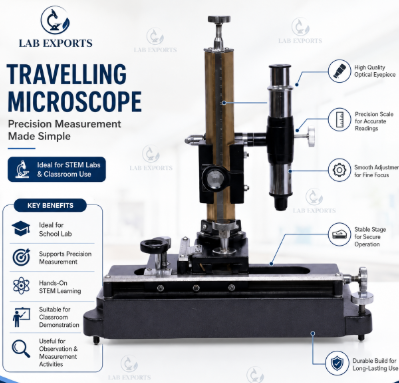
Quick answer: The Travelling Microscope is a focusing microscope carried on a guided, graduated movement, used to measure small distances precisely by sighting two points in turn and reading the scale at each. Its best-known use is finding the refractive index of glass or a liquid from real and apparent depth. Lab Exports manufactures it in Delhi for schools, colleges and universities.
Specifications
| Component | Specification |
|---|---|
| Instrument type | Optical positional measuring instrument |
| Construction | Focusing microscope with guided movement and graduated measuring arrangement |
| Reading | Scale reading taken at each sighted position |
| Operation | Manual |
| Typical uses | Apparent depth, small displacements, capillary rise |
Travel, least count and magnification are not stated on this page; give the values needed when requesting a quote.
How the travelling microscope experiment is done
A travelling microscope measures the distance between two points that are too close or too fine to measure with a ruler. The microscope is focused on the first point and the scale is read; it is then moved along its guide and focused on the second point, and the difference between the two readings is the distance. For refractive index, the ratio mu = real depth / apparent depth is found from three readings.
- Level the instrument and focus the microscope on a cross mark on paper; note the reading R1.
- Place the glass slab over the mark and refocus on the image of the mark; note R2.
- Sprinkle a little lycopodium powder or chalk dust on top of the slab, focus on it and note R3.
- Real depth = R3 - R1 and apparent depth = R3 - R2, so mu = (R3 - R1) / (R3 - R2).
- Repeat each focusing several times, always approaching from the same direction to avoid backlash.
The same method works for a liquid in a beaker, and the microscope is also used to read the bore of a capillary tube and the height of liquid rise in surface-tension experiments.
Key features
- Focusing microscope for sighting fine marks, images and liquid surfaces.
- Guided movement so the microscope can be moved between reference points.
- Graduated measuring arrangement to read each position.
- Supports refractive index, capillary-rise and small-displacement practicals.
- Manual instrument, with no power needed for measurement.
Documentation and supply
Most Lab Exports products carry a one-year manufacturer warranty.
Lab Exports manufactures the travelling microscope at its works in Laxmi Nagar, Delhi, and supplies it to schools, colleges and universities in India and 60+ countries, handling the export documents for each shipment. More about the company is on the About Lab Exports page.
Related Lab Meters products
- Screw Gauge / Micrometer (SCL-LM-11255)
- Lens Holder V Shape Stop Clock (SCL-LM-11254)
- Digital Multimeter (SCL-LM-11250)
- Vernier Caliper Stainless (SCL-LM-11249)
- Digital Vernier Caliper (SCL-LM-11247)
- MO65 Analog Panel Meter (SCL-LM-11289)
The full range is in the Lab Meters section of the Physics Lab range.
Frequently asked questions
How is refractive index found with a travelling microscope?
By reading the microscope position when focused on a mark, on its image through the slab or liquid, and on the top surface. Refractive index = real depth / apparent depth.
Which experiments use a travelling microscope?
Refractive index of glass and liquids by apparent depth, measuring the bore of a capillary tube and capillary rise, and other small vertical or horizontal displacements.
What is the price of the travelling microscope?
Prices are not published on the website. Add the travelling microscope to the Enquiry Cart with the Add To Cart button on this page, or email [email protected] with the house code SCL-LM-11256 and the quantity, to receive a quotation.
Does Lab Exports manufacture the travelling microscope?
Yes. Lab Exports manufactures the travelling microscope at its works at 11/315, Lalita Park, Laxmi Nagar, Delhi 110092, under house code SCL-LM-11256.
Request a quote
Email [email protected] with the house code SCL-LM-11256 and the quantity, or add the travelling microscope to the Enquiry Cart with the Add To Cart button on this page. Tender buyers can also see the Tenders and OEM page.