Resistance in Series and Parallel Apparatus
Product Code : SCL-EAE-11187
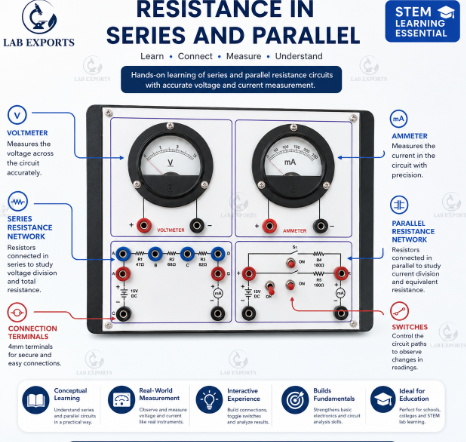
Quick answer: The Resistance in Series and Parallel Apparatus is a ready-wired board for verifying the laws of combination of resistances. Known-value ceramic power resistors sit under a printed schematic with 4 mm binding posts, so students connect them in series or in parallel, measure the equivalent resistance and compare it with theory. Lab Exports manufactures it in Delhi for schools and colleges.
Specifications
| Component | Specification |
|---|---|
| Resistors | Ceramic power resistors of known values |
| Terminals | 4 mm safety socket binding posts, nickel-plated brass |
| Base | Insulated, non-conductive panel with printed circuit schematic and non-slip feet |
| Recommended input | 0 to 12 V DC |
How the series and parallel experiment is done
For resistors in series the same current flows through each and the voltages add, so the equivalent resistance is R = R1 + R2 + R3. In parallel the voltage across each branch is the same and the currents add, giving 1/R = 1/R1 + 1/R2 + 1/R3; the combined resistance is always less than the smallest single resistor.
- Place the board flat on a dry bench and connect a low-voltage variable DC supply, staying within 0 to 12 V.
- Link the resistors in series using the binding posts, with an ammeter in series and a voltmeter across the combination.
- Record the current and voltage and calculate the equivalent resistance as V/I.
- Rewire the resistors in parallel and repeat the measurements.
- Compare each measured value with the value calculated from the series and parallel formulae.
The same board shows voltage division across a series chain and current division between parallel branches, and gives students practice in connecting a digital multimeter correctly as an ammeter and as a voltmeter.
Key features
- Printed schematic on the board that matches textbook circuit diagrams.
- Ceramic power resistors of known value that hold steady as they warm.
- 4 mm nickel-plated brass binding posts for low-resistance connections.
- Non-conductive base with non-slip feet for safe bench use.
- Self-contained board, ready for use without assembly.
Documentation and supply
A student manual with circuit diagrams and worked equations is supplied with the apparatus. Most Lab Exports products carry a one-year manufacturer warranty.
Lab Exports manufactures the series and parallel resistance apparatus at its works in Laxmi Nagar, Delhi, and supplies it to schools and colleges in India and 60+ countries, handling the export documents for each shipment. More about the company is on the About Lab Exports page.
Related Electrical and Electronics products
- Rheostat 8" (100 ohm 1.6A) (SCL-EAE-11189)
- VIPOW AA Rechargeable Battery (SCL-EAE-11191)
- Operational Amplifier Trainer (SCL-EAE-11182)
- Energy Band Gap Apparatus (SCL-EAE-11181)
- Portable Wheatstone Bridge (SCL-EAE-11193)
- Lamps in Parallel Kit (SCL-EAE-11194)
The full range is in the Electrical and Electronics section of the Physics Lab range.
Frequently asked questions
What does the series and parallel resistance apparatus verify?
It verifies that resistances in series add, R = R1 + R2 + R3, and that for resistances in parallel 1/R = 1/R1 + 1/R2 + 1/R3.
What supply voltage should be used with the board?
A low-voltage DC supply in the recommended range of 0 to 12 V.
What is the price of the series and parallel resistance apparatus?
Prices are not published on the website. Add the series and parallel resistance apparatus to the Enquiry Cart with the Add To Cart button on this page, or email [email protected] with the house code SCL-EAE-11187 and the quantity, to receive a quotation.
Does Lab Exports manufacture the series and parallel resistance apparatus?
Yes. Lab Exports manufactures the series and parallel resistance apparatus at its works at 11/315, Lalita Park, Laxmi Nagar, Delhi 110092, under house code SCL-EAE-11187.
Request a quote
Email [email protected] with the house code SCL-EAE-11187 and the quantity, or add the series and parallel resistance apparatus to the Enquiry Cart with the Add To Cart button on this page. Tender buyers can also see the Tenders and OEM page.