Primary Color Apparatus
Product Code : SCL-LAO-11320
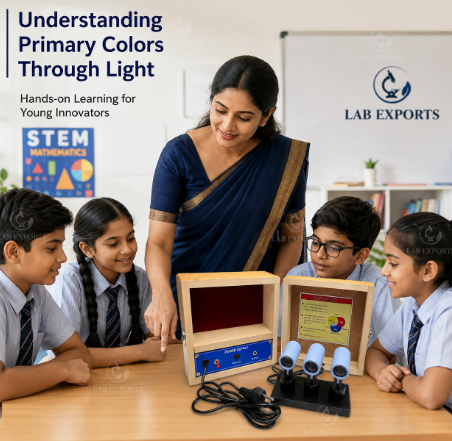
Quick answer: The primary color apparatus demonstrates additive colour mixing with red, green and blue light. Two overlapping primaries give the secondary colours yellow, cyan and magenta, and balanced red, green and blue together appear white, the RGB principle behind screens and displays. The lamp and power arrangement is confirmed with the quotation. Lab Exports manufactures it in Delhi for schools, colleges and universities.
Specifications
| Parameter | Detail |
|---|---|
| Demonstration principle | Additive colour synthesis |
| Primary light colours | Red, green and blue |
| Results shown | Secondary colours from two-beam overlap; white from all three |
| Supplied as | One apparatus; accessories as stated in the quotation |
Lamp type, power requirement, controls and construction are confirmed with the quotation.
How the apparatus is used in teaching
Coloured light mixes by addition: each beam adds its own band of wavelengths to what reaches the eye. Red and green light together are seen as yellow, green and blue as cyan, red and blue as magenta, and all three in the right balance as white. Pigments behave the other way, because each paint absorbs, or subtracts, part of the spectrum, so mixing paints darkens the result.
- Set the apparatus on a stable bench in a darkened room, facing a white surface.
- Project one colour at a time and let students name each primary.
- Overlap two beams at a time and record the secondary colour formed.
- Overlap all three and compare the result with a mixture of red, green and blue paint.
Key features
- Shows red, green and blue as the primary colours of light.
- Overlapping two beams gives the secondary colours for direct observation.
- All three primaries combined show how white light is built up.
- Makes additive synthesis visible instead of relying on diagrams.
- Links optics lessons to the RGB principle of screens and digital imaging.
- Suits teacher-led demonstrations, supervised practicals and science exhibitions.
Documentation and supply
Most Lab Exports products carry a one-year manufacturer warranty.
Lab Exports manufactures the primary color apparatus at its works in Laxmi Nagar, Delhi, and supplies it to schools, colleges and universities in India and 60+ countries, handling the export documents for each shipment. More about the company is on the About Lab Exports page.
Related Light and Optics products
- Lens Holder V Shape (SCL-LAO-11253)
- Convex Mirror (SCL-LAO-11237)
- Concave Mirror (SCL-LAO-11236)
- Concave Lens (SCL-LAO-11235)
- Convex Lens (SCL-LAO-11234)
- Ray Optics Kit (SCL-LAO-11229)
The full range is in the Light and Optics section of the Physics Lab range.
Frequently asked questions
What colours are formed in the primary color apparatus?
Red plus green gives yellow, green plus blue gives cyan, red plus blue gives magenta, and red, green and blue together give white.
How is mixing light different from mixing paints?
Light mixing is additive, so combined beams get brighter and approach white; paint mixing is subtractive, because each pigment absorbs part of the spectrum, so the mixture gets darker.
Request a quote
Email [email protected] with the house code SCL-LAO-11320 and the quantity, or add the primary color apparatus to the Enquiry Cart with the Add To Cart button on this page. Tender buyers can also see the Tenders and OEM page.