Hydro Power Model
Product Code : SCL-AM-11156
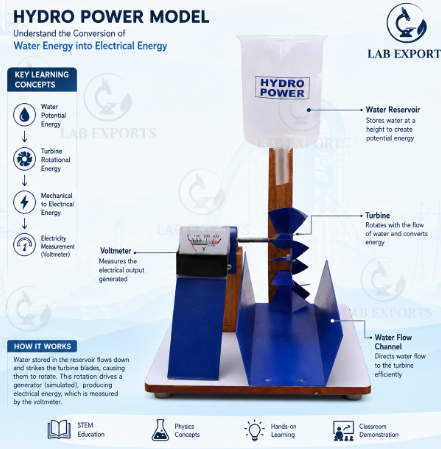
Quick answer: The Hydro Power Model is a physics teaching model that shows how moving water turns a rotating mechanism, the working principle of hydropower. It is used in lessons on renewable energy and on energy conversion from flowing water to mechanical motion. Lab Exports manufactures it in Delhi for schools, colleges and universities.
Specifications
| Item | Specification |
|---|---|
| Educational principle | Hydropower - water-driven motion and energy conversion |
| Subject area | Physics, renewable energy and STEM lessons |
| Use | Teacher-led classroom demonstration |
The component list and any electrical output of the current configuration are available from [email protected] on request.
How the model is used in teaching
Hydropower uses the energy of moving water. Water held at a height h has potential energy mgh; as it falls or flows this becomes kinetic energy, and when the stream strikes the blades of a wheel or turbine part of that energy turns the shaft. In a hydroelectric station the turbine shaft drives a generator, so the chain runs from potential energy to kinetic energy to mechanical energy to electrical energy.
The Hydro Power Model lets students watch the first stages of that chain: water directed at the rotating part makes it turn, and a stronger flow turns it faster. Teachers use it to open lessons on renewable energy, energy transformation and why dams store water at a height.
Key features
- Shows water-driven rotational motion that students can observe directly
- Supports lessons on energy transformation from moving water to mechanical energy
- A practical starting point for teaching how hydroelectric power stations work
- Suited to teacher-led demonstrations in physics, environmental science and STEM classes
- Complements other applied mechanics and renewable energy teaching aids in the physics lab
Documentation and supply
Most Lab Exports products carry a one-year manufacturer warranty.
Lab Exports manufactures the Hydro Power Model at its works in Laxmi Nagar, Delhi, and supplies it to schools, colleges and universities in India and 60+ countries, handling the export documents for each shipment. More about the company is on the About Lab Exports page.
Related Applied Mechanics products
- Anti Gravity Cone (SCL-AM-11157)
- Hydraulic Brake Model (SCL-AM-11154)
- Newton's Cradle Model (SCL-AM-11165)
- Bob Set of 6 Metals (SCL-AM-11146)
- Newton's Third Law Model (3rd Law of Motion Apparatus) (SCL-AM-11166)
- Newton's Second Law Model (2nd Law of Motion Apparatus) (SCL-AM-11167)
The full range is in the Applied Mechanics section of the Physics Lab range.
Frequently asked questions
What does a hydro power model demonstrate?
It demonstrates how the energy of moving water can turn a rotating mechanism, the principle used by turbines in hydroelectric power stations.
What energy changes does the model illustrate?
Potential energy of water at a height becomes kinetic energy as it flows, and the moving water passes energy to the rotating part as mechanical energy. In a full power station a generator then converts this to electrical energy.
What is the price of the Hydro Power Model?
Prices are not published on the website. Add the Hydro Power Model to the Enquiry Cart with the Add To Cart button on this page, or email [email protected] with the house code SCL-AM-11156 and the quantity, to receive a quotation.
Does Lab Exports manufacture the Hydro Power Model?
Yes. Lab Exports manufactures the Hydro Power Model at its works at 11/315, Lalita Park, Laxmi Nagar, Delhi 110092, under house code SCL-AM-11156.
Request a quote
Email [email protected] with the house code SCL-AM-11156 and the quantity, or add the Hydro Power Model to the Enquiry Cart with the Add To Cart button on this page. Tender buyers can also see the Tenders and OEM page.