Conversion of Galvanometer Manufacturer,Supplier and Exporter in India

Conversion of Galvanometer
Product Code : SCL-EAE-11201

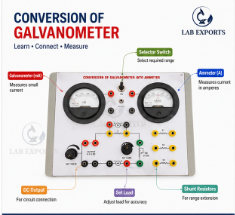
The Conversion of Galvanometer apparatus supports the experimental study of electrical measuring instruments. During the ammeter-conversion experiment, a low-value shunt resistance is connected in parallel with the galvanometer. During the voltmeter-conversion experiment, a high-value resistance is connected in series with the galvanometer.

The setup helps students connect circuit theory with actual meter behaviour. Learners can study galvanometer resistance, figure of merit, current range, voltage range and resistance selection through supervised practical work. The exact meter range, resistance values, construction materials and supplied accessories must be confirmed from the final Lab Exports product specification.

Key Features

Two practical applications: Supports the study of galvanometer conversion into both an ammeter and a voltmeter.

Demonstrates shunt resistance: Shows how a low resistance connected in parallel extends the measurable current range.

Demonstrates series resistance: Shows how a high resistance connected in series enables voltage measurement.

Supports quantitative experiments: Allows students to calculate the required resistance using measured circuit values.

Suitable for teaching laboratories: Relevant to secondary-school, senior-secondary, college and introductory engineering practical work.

Reinforces circuit connections: Helps learners distinguish correctly between parallel ammeter connections and series voltmeter connections.

Reusable laboratory apparatus: Intended for repeated demonstrations and practical sessions when operated within its verified ratings.

Technical Specifications

Specification

Detail

Product Name

Conversion of Galvanometer

Brand

Lab Exports

Product Category

Physics Laboratory Electrical Measurement Apparatus

Experiment

Conversion of a galvanometer into an ammeter and a voltmeter

Primary Principle

Extension of measuring range using parallel shunt resistance or series resistance

Galvanometer Range

[confirm]

Ammeter Conversion Range

[confirm]

Voltmeter Conversion Range

[confirm]

Resistance Values

[confirm]

Construction Material

[confirm]

Dimensions and Weight

[confirm]

Standards or Certifications

No product-specific standard or certification verified

What’s Included in the Kit

Galvanometer or galvanometer module — [confirm]

Shunt-resistance arrangement — [confirm values]

Series-resistance arrangement — [confirm values]

Connection terminals or circuit board — [confirm]

Connecting leads — [confirm quantity]

Experiment manual or instruction sheet — [confirm]

The final bill of materials should be verified before publication or procurement because an approved component list was not supplied.

Applications / Uses

Converting a galvanometer into an ammeter.

Converting a galvanometer into a voltmeter.

Studying shunt resistance and series resistance.

Determining the resistance of a galvanometer.

Understanding the figure of merit of a galvanometer.

Comparing calculated and observed meter readings.

Teaching current electricity and electrical measurements.

Conducting supervised school and college physics practicals.

How to Use the Conversion of Galvanometer Apparatus

Identify the galvanometer terminals, resistance components and intended experiment range.

Determine the galvanometer resistance and full-scale deflection current using the prescribed laboratory method.

For ammeter conversion, calculate the required shunt resistance and connect it in parallel with the galvanometer.

Connect the converted ammeter in series with the test circuit.

For voltmeter conversion, calculate the required high resistance and connect it in series with the galvanometer.

Connect the converted voltmeter in parallel across the circuit element being tested.

Apply power gradually and compare the observed readings with a reference meter where available.

Record the readings, calculations, percentage error and experimental observations.

Safety note: Switch off the power supply before changing connections. Confirm polarity, begin with the lowest safe current and never exceed the verified galvanometer or resistor ratings.

Care & Maintenance

Keep the galvanometer disconnected when the apparatus is not in use.

Store the equipment in a dry cabinet away from dust, moisture and strong magnetic fields.

Avoid mechanical shock and do not force the meter pointer or adjustment control.

Inspect leads, terminals and resistance components before each practical session.

Why Choose Lab Exports?

Lab Exports manufactures and exports scientific laboratory instruments, educational experiment setups, science kits, mathematics kits, didactic models and STEM equipment. Its physics range includes equipment for electrical measurement, electronics, magnetism and classroom experiments. Buyers planning a complete laboratory can explore physics laboratory equipmentelectrical and electronics apparatuslaboratory meters and magnetism laboratory equipment.

Frequently Asked Questions

What is the Conversion of Galvanometer apparatus used for?

It is used to study how a galvanometer can function as an ammeter or voltmeter after adding a correctly calculated resistance.

How is a galvanometer converted into an ammeter?

A low-value shunt resistance is connected in parallel with the galvanometer. Most of the measured current passes through the shunt, protecting the galvanometer coil and extending the current range.

How is a galvanometer converted into a voltmeter?

A high resistance is connected in series with the galvanometer. The resistance limits current through the coil and enables measurement of a specified potential difference.

Why is an ammeter connected in series?

An ammeter is connected in series so the circuit current passes through it. A converted ammeter should have low effective resistance to minimise disturbance to the circuit.

Why is a voltmeter connected in parallel?

A voltmeter is connected across a component to measure potential difference. Its effective resistance should be high so that it draws minimal current from the circuit.

Is this apparatus suitable for school laboratories?

Yes. It is suitable for supervised senior-secondary, college and introductory technical laboratory work when the supplied ranges match the prescribed experiment.

Request the confirmed ranges, component list and quotation for the Conversion of Galvanometer apparatus, or browse the complete electrical and electronics laboratory equipment range from Lab Exports.

Recommended image ALT text: Conversion of Galvanometer apparatus for ammeter and voltmeter physics experiments by Lab Exports.


Supply of Conversion of Galvanometer from to Finland, France, Tanzania, Thailand, Sri Lanka, Congo, Costa Rica, Ivory Coast, Croatia, Cuba, Cyprus, Czech Republic, Denmark, Djibouti, Dominica, Afghanistan, Albania, Algeria, Andorra, Angola, Antigua and Barbuda, Argentina, Armenia, Australia, Austria, Azerbaijan, Bahamas, Bahrain, Bangladesh, Barbados, United Arab Emirates (UAE, Dubai), United Kingdom (London), United States, Uruguay, Uzbekistan, Vanuatu, Belarus, Belgium, Belize, Benin, Bhutan, Bolivia, Bosnia and Herzegovina, Botswana, Brazil, Brunei, Bulgaria, Burkina Faso, Burma Myanmar, East Timor, Ecuador, Egypt, El Salvador, Equatorial Guinea, Eritrea, Estonia, Ethiopia (Addis Ababa), Fiji, Burundi, Cambodia, Cameroon, Canada, Cape Verde, Central African Republic, Chad, Chile, Colombia. Math Teaching Kit suppliers in Luxembourg, Macedonia, Madagascar, Malawi (Lilongwe), Malaysia (Kuala Lumpur), Maldives, Mali, Malta, Marshall Islands, Mauritania, Mexico, Micronesia, Moldova, Monaco, Mongolia, Montenegro, Morocco, Mozambique, Namibia, Comoros, Congo. Math Teaching Kit manufacturers in Dominican Republic, Gabon, Gambia, Georgia, Germany, Ghana, Greece, Grenada, Guatemala, Guinea, Guinea-Bissau, Guyana, Haiti, Honduras, Hungary, Iceland, Indonesia, Iran, Iraq, Niger, Nigeria (Abuja), Norway, Oman, Palau, Panama, Papua New Guinea, Paraguay, Peru, Philippines (Manila), Poland, Ireland, Israel, Italy, Jamaica, Japan, Jordan, Kazakhstan, Kenya (Nairobi), Kiribati, Korea, Kuwait, Kyrgyzstan, Laos, Latvia, Lebanon, Lesotho, Liberia, Liechtenstein, Lithuania, Mauritius, Nauru, Nepal, Netherlands, New Zealand, Nicaragua, Portugal, Qatar, Romania, Russia, Rwanda (Kigali). Math Teaching Kit exportets to Saint Kitts and Nevis, Saint Lucia, Saint Vincent and the Grenadines, Samoa, San Marino, Sao Tome and Principe, Saudi Arabia, Senegal, Serbia, Seychelles, Sierra Leone, Singapore, Slovakia, Slovenia, Solomon Islands, Somalia, South Africa, South Sudan, Spain, Sudan, Suriname, Swaziland, Sweden, Switzerland, Syria, Tajikistan, Togo, Tonga, Trinidad and Tobago, Tunisia, Turkey, Turkmenistan, Tuvalu, Uganda (Kampala), Ukraine, Venezuela, Vietnam, Yemen , Zambia (Lusaka), Zimbabwe

Office Address

Works:11/315, Lalita Park, Laxmi Nagar, Delhi, 110092

[email protected]

Follow Us