Force and Friction Model

Product Code : SCL-AM-11114
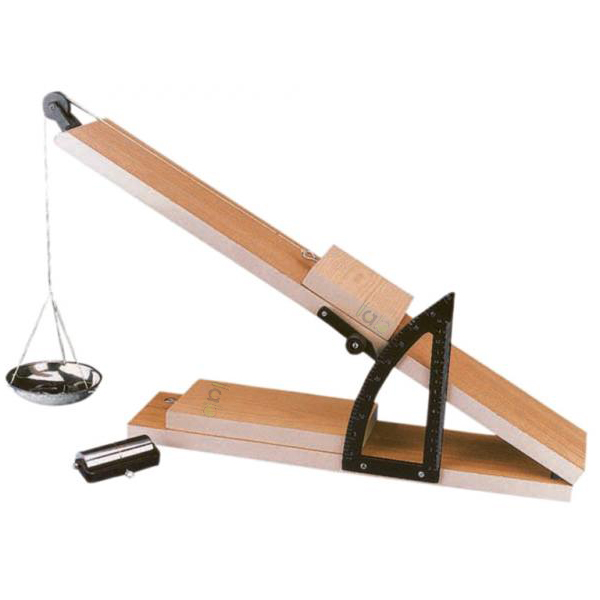
Quick answer: The Force and Friction Model is a single demonstration model for lessons on friction as a force that opposes motion between surfaces in contact. It is used to compare the force needed to start and to keep up motion, and how extra load changes frictional resistance. The basic demonstration is mechanical. Lab Exports manufactures it in Delhi for schools, colleges and universities.
Specifications
| Parameter | Detail |
|---|---|
| Format | Single demonstration model |
| Topics | Applied force, frictional resistance, static friction, sliding friction, load effect and motion |
| Power | None needed for the basic mechanical demonstration |
For materials, dimensions and included accessories, email [email protected] with the house code SCL-AM-11114.
How it is used in teaching
Friction acts along the surface of contact and opposes motion or attempted motion. Before an object moves, static friction grows to match the applied force up to a limit, F = mu_s N, where N is the normal reaction; once sliding begins, kinetic friction F = mu_k N is usually a little smaller, so less force is needed to keep the object moving than to start it.
Because both limits are proportional to N, adding load raises the frictional resistance in the same proportion. The model lets a class see these ideas directly and compare the force needed to start and maintain motion under different conditions.
- Place the model on a clean, level and stable table.
- Apply a slowly increasing pull, for example with a spring balance, and note the force at which motion just starts.
- Keep the object moving steadily and note the smaller force needed.
- Add load and repeat, then compare the results and discuss the coefficients of friction.
Key features
- Single mechanical demonstration model; no electrical supply needed for basic use
- Shows that friction acts opposite to motion or attempted motion
- Supports comparison of static and sliding friction
- Shows the effect of added load on frictional resistance
- Suited to teacher demonstrations, student experiments and STEM activities
Documentation and supply
Most Lab Exports products carry a one-year manufacturer warranty.
Lab Exports manufactures the force and friction model at its works in Laxmi Nagar, Delhi, and supplies it to schools, colleges and universities in India and 60+ countries, handling the export documents for each shipment. More about the company is on the About Lab Exports page.
Related Applied Mechanics products
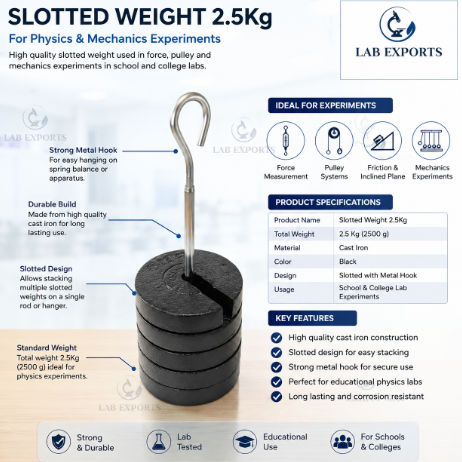
- Slotted Weight 2.5 Kg (SCL-AM-11141)
- Physical Weight Box Iron (SCL-AM-11144)
- Bob Set of 6 Metals (SCL-AM-11146)
- Hydraulic Brake Model (SCL-AM-11154)
- Hydro Power Model (SCL-AM-11156)
- Anti Gravity Cone (SCL-AM-11157)
The full range is in the Applied Mechanics section of the Physics Lab range.
Frequently asked questions
What does the Force and Friction Model teach?
It teaches applied force, static and sliding friction, and how load affects frictional resistance and motion.
Does the friction model need a power supply?
No. The basic friction demonstration is mechanical.
What is the price of the force and friction model?
Prices are not published on the website. Add the force and friction model to the Enquiry Cart with the Add To Cart button on this page, or email [email protected] with the house code SCL-AM-11114 and the quantity, to receive a quotation.
Does Lab Exports manufacture the force and friction model?
Yes. Lab Exports manufactures the force and friction model at its works at 11/315, Lalita Park, Laxmi Nagar, Delhi 110092, under house code SCL-AM-11114.
Request a quote
Email [email protected] with the house code SCL-AM-11114 and the quantity, or add the force and friction model to the Enquiry Cart with the Add To Cart button on this page. Tender buyers can also see the Tenders and OEM page.