Windmill Model – Small
Product Code : SCL-AM-11220
Quick answer: The Windmill Model - Small is a compact tabletop teaching model whose blades turn when air flows past them, from natural wind or a classroom fan. It is used to show how wind energy becomes mechanical motion in renewable energy and STEM lessons. Lab Exports manufactures it in Delhi for schools, colleges and universities.
Specifications
| Item | Specification |
|---|---|
| Category | Renewable energy educational model |
| Model size | Small, tabletop |
| Operation | Blades turned by airflow from natural wind or a classroom fan |
| Application | Science education and STEM demonstration |
How the model is used in teaching
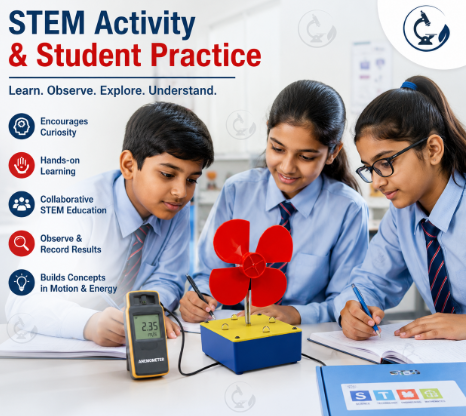
Moving air carries kinetic energy. When wind strikes the angled blades of a windmill it pushes them round, and part of that energy becomes rotational energy of the rotor. In a modern wind turbine the rotor shaft drives a generator; in a traditional windmill it drove a pump or millstones.
The power available in the wind is P = 1/2 rho A v^3, where rho is the density of air, A the area swept by the blades and v the wind speed. Because power depends on the cube of wind speed, a modest increase in airflow makes a large difference, and students can see the rotor speed up as the fan is turned up or moved closer.
- Stand the model on a flat surface where the blades can turn freely.
- Check by hand that the rotor spins without catching.
- Direct natural wind or a classroom fan at the blades and observe the rotation.
- Change the fan speed or distance and compare how fast the blades turn.
- Discuss how wind farms convert the same motion into electricity.
Key features
- Compact tabletop size suited to lab benches and classroom presentations
- Blades respond to natural wind or airflow from a classroom fan
- Shows wind-driven mechanical movement in an easy-to-follow form
- Supports lessons on energy conversion, environmental science and engineering basics
- Reusable for repeated classroom activities and science exhibitions
Documentation and supply
Most Lab Exports products carry a one-year manufacturer warranty.
Lab Exports manufactures the Windmill Model - Small at its works in Laxmi Nagar, Delhi, and supplies it to schools, colleges and universities in India and 60+ countries, handling the export documents for each shipment. More about the company is on the About Lab Exports page.
Related Applied Mechanics products
- DCC Copper Wire (100gm) (SCL-AM-11223)
- Inclined Plane Apparatus (SCL-AM-11224)
- Vernier Caliper IME Type (SCL-AM-11188)
- Newton's 1st Law Model (SCL-AM-11168)
- Newton's Second Law Model (2nd Law of Motion Apparatus) (SCL-AM-11167)
- Newton's Third Law Model (3rd Law of Motion Apparatus) (SCL-AM-11166)
The full range is in the Applied Mechanics section of the Physics Lab range.
Frequently asked questions
What is the small windmill model used for?
It demonstrates how moving air turns a set of blades, showing the conversion of wind energy into mechanical energy in science and STEM lessons.
How is the windmill model operated?
Place it on a flat surface and let natural wind or airflow from a classroom fan reach the blades; they rotate as the air passes.
What is the price of the Windmill Model - Small?
Prices are not published on the website. Add the Windmill Model - Small to the Enquiry Cart with the Add To Cart button on this page, or email [email protected] with the house code SCL-AM-11220 and the quantity, to receive a quotation.
Does Lab Exports manufacture the Windmill Model - Small?
Yes. Lab Exports manufactures the Windmill Model - Small at its works at 11/315, Lalita Park, Laxmi Nagar, Delhi 110092, under house code SCL-AM-11220.
Request a quote
Email [email protected] with the house code SCL-AM-11220 and the quantity, or add the Windmill Model - Small to the Enquiry Cart with the Add To Cart button on this page. Tender buyers can also see the Tenders and OEM page.