
Hydraulic Brake Model
Product Code : SCL-AM-11154
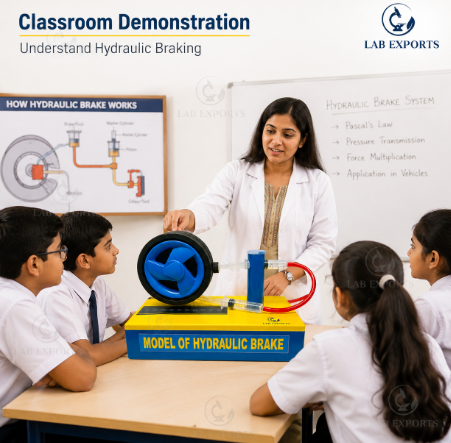
Quick answer: The Hydraulic Brake Model is a mounted classroom model that demonstrates Pascal's law and the working of hydraulic brakes. Pressing one syringe-type actuator sends pressure through flexible tubing to a second actuator that brakes a wheel. Lab Exports manufactures it in Delhi for schools, colleges and universities.
Specifications
| Item | Specification |
|---|---|
| Principle | Pascal's law - transmission of pressure through an enclosed liquid |
| Components | Wheel and brake demonstration assembly, two syringe-type actuators, flexible connecting tubing |
| Mounting | All parts assembled on a common base |
| Operation | Manual, by pressing the input actuator |
| Subject area | Physics - applied mechanics and fluid pressure |
How the model is used in teaching
Pascal's law states that pressure applied to an enclosed fluid is transmitted undiminished to every part of the fluid. In the model, pushing the plunger of one syringe, which plays the part of the master cylinder, raises the pressure of the liquid in the tubing; the second syringe at the wheel then moves and applies the brake.
Because the pressure p = F/A is the same at both ends, the output force is F2 = F1 x A2/A1, so an output piston of larger area delivers a larger force. A car's brakes work the same way: the pedal drives a master cylinder, and brake fluid carries the pressure to the cylinders at each wheel.
- Place the model on a level bench and check that the tubing is firmly connected to both syringes.
- Press the plunger of the input syringe slowly and watch the output syringe move at the wheel.
- Observe the brake act on the wheel, then draw the plunger back and watch it release.
- Discuss where the force is applied, how the pressure travels through the liquid and how a vehicle brake system uses the same principle.
Key features
- Demonstrates Pascal's law with a visible hydraulic path from input to wheel
- Two syringe-type actuators linked by flexible tubing show cause and effect directly
- Wheel and brake assembly relates the physics to real vehicle braking
- All parts mounted on one base for teacher-led demonstration
- Hands-on operation for supervised student use in physics and STEM lessons
What is included
- 1 x mounted hydraulic brake model
- 1 x wheel and brake demonstration assembly
- 2 x syringe-type hydraulic actuators
- 1 x flexible connecting tube arrangement
Documentation and supply
Most Lab Exports products carry a one-year manufacturer warranty.
Lab Exports manufactures the Hydraulic Brake Model at its works in Laxmi Nagar, Delhi, and supplies it to schools, colleges and universities in India and 60+ countries, handling the export documents for each shipment. More about the company is on the About Lab Exports page.
Related Applied Mechanics products
- Hydro Power Model (SCL-AM-11156)
- Anti Gravity Cone (SCL-AM-11157)
- Bob Set of 6 Metals (SCL-AM-11146)
- Physical Weight Box Iron (SCL-AM-11144)
- Newton's Cradle Model (SCL-AM-11165)
- Newton's Third Law Model (3rd Law of Motion Apparatus) (SCL-AM-11166)
The full range is in the Applied Mechanics section of the Physics Lab range.
Frequently asked questions
What does the hydraulic brake model demonstrate?
It demonstrates Pascal's law: pressure applied at one syringe is carried through the liquid in the tubing to the second syringe, which operates the brake on the wheel.
Where is the principle used in real life?
In the hydraulic brakes of cars and motorcycles, and in other hydraulic machines such as jacks and presses, where a small input force is turned into a larger output force.
What is the price of the Hydraulic Brake Model?
Prices are not published on the website. Add the Hydraulic Brake Model to the Enquiry Cart with the Add To Cart button on this page, or email [email protected] with the house code SCL-AM-11154 and the quantity, to receive a quotation.
Does Lab Exports manufacture the Hydraulic Brake Model?
Yes. Lab Exports manufactures the Hydraulic Brake Model at its works at 11/315, Lalita Park, Laxmi Nagar, Delhi 110092, under house code SCL-AM-11154.
Request a quote
Email [email protected] with the house code SCL-AM-11154 and the quantity, or add the Hydraulic Brake Model to the Enquiry Cart with the Add To Cart button on this page. Tender buyers can also see the Tenders and OEM page.
ApparatusVerticalPattern.jpg)