Kaleidoscope Manufacturer,Supplier and Exporter in India

Kaleidoscope

Product Code : SCL-LAO-11142

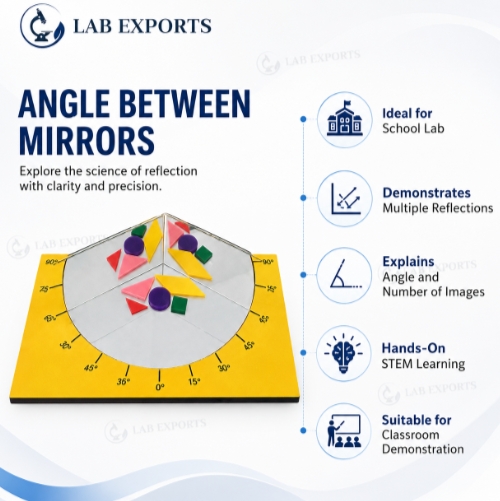
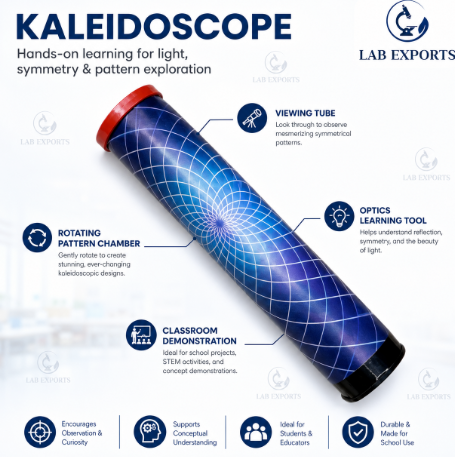
A kaleidoscope creates repeated symmetrical patterns through multiple reflections inside an enclosed optical arrangement. When the viewing position or internal pattern elements change, the observer sees changing geometric images formed by repeated reflection.

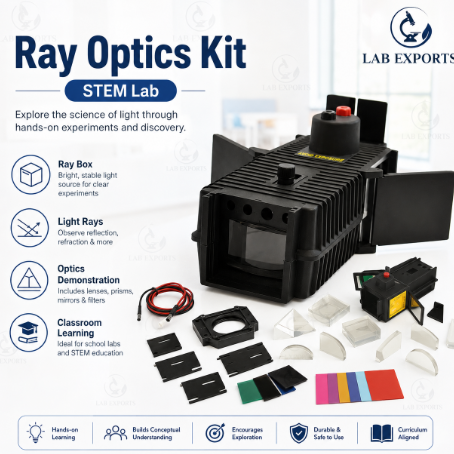
This apparatus supports practical teaching of reflection, symmetry, image formation, and basic optics. It can complement other light and optics laboratory equipment used for demonstrations of mirrors, lenses, light paths, and optical phenomena.

Key Features

Demonstrates multiple reflection: Helps learners observe how repeated reflections can form complex visual patterns.

Supports optics education: Suitable for explaining reflection, symmetry, image repetition, and basic geometrical optics.

Direct visual observation: Allows students to see changing symmetrical patterns through the viewing end of the apparatus.

Suitable for classroom demonstrations: Useful for teacher-led demonstrations, individual observation, and introductory practical activities.

Simple operating principle: Requires no complex experimental procedure for basic observation.

Broad educational relevance: Suitable for school science laboratories, college physics demonstrations, STEM activities, and science education programs.

Technical Specifications

Specification

Detail

Product Name

Kaleidoscope

Primary Keyword

Kaleidoscope for Physics Lab

Product Category

Physics Laboratory Equipment / Light and Optics Equipment

Operating Principle

Multiple reflection and formation of repeating symmetrical patterns

Intended Users

Schools, colleges, universities, science laboratories, teachers, students, and STEM education programs

Standards or Certifications

No product-specific standard or certification supplied

What's Included in the Kit

One Kaleidoscope apparatus

Any additional accessories, replaceable pattern elements, storage case, or instructional literature should be confirmed from the final production specification before publication or procurement.

Applications / Uses

Demonstrating multiple reflection in an educational setting.

Observing repeating symmetrical and geometric patterns.

Introducing students to basic concepts of geometrical optics.

Supporting classroom discussions of mirrors and image formation.

Conducting visual science demonstrations and STEM activities.

Complementing other physics laboratory equipment used for practical science instruction.

How to Use the Kaleidoscope

Hold the kaleidoscope securely in a comfortable viewing position.

Point the appropriate end toward a suitable light source or illuminated surroundings without looking directly at an intense light source.

Look through the viewing end of the apparatus.

Rotate or reposition the kaleidoscope slowly, depending on its design.

Observe how the internal visual pattern changes and forms repeated symmetrical images.

Relate the observed patterns to the principles of reflection, symmetry, and image repetition.

Safety note: Never point the kaleidoscope directly at the Sun, lasers, or other intense light sources. Handle the apparatus carefully and avoid impact or dropping.

Care & Maintenance

Keep the viewing surfaces clean and free from dust, fingerprints, and moisture.

Use a soft, dry cloth for routine external cleaning.

Store the apparatus in a dry location when not in use.

Avoid dropping, crushing, or exposing the kaleidoscope to excessive moisture or heat.

Why Choose Lab Exports

Lab Exports manufactures and exports scientific laboratory instruments, experiment setups, science kits, mathematics kits, didactic models, and STEM educational equipment. Its product range supports schools, colleges, universities, laboratories, and institutional procurement requirements. Buyers can also explore related physics miscellaneous products for additional educational demonstrations and practical laboratory activities. Final specifications should always be checked against the required curriculum, tender, or procurement document before ordering.

Frequently Asked Questions

What is a kaleidoscope used for in a physics lab?

A kaleidoscope is used to demonstrate multiple reflection, symmetry, and the formation of repeating optical patterns. It provides a direct visual introduction to basic geometrical optics.

How does a kaleidoscope form symmetrical patterns?

A kaleidoscope forms patterns through repeated reflections within its internal optical arrangement. The resulting images appear as repeated geometric and symmetrical designs.

Is a kaleidoscope suitable for school science laboratories?

Yes. A kaleidoscope is suitable for school science demonstrations, introductory optics lessons, STEM activities, and individual student observation.

Can a kaleidoscope be used to teach reflection?

Yes. It helps students visually observe the effects of multiple reflection and understand how repeated images can create complex symmetrical patterns.

What material is this kaleidoscope made from?

The material has not been specified in the supplied product data. It should be confirmed from the final production specification before publishing a material claim.

Does the kaleidoscope require electricity?

No electrical requirement is stated for this product. A conventional educational kaleidoscope operates through optical reflection and ambient or suitable external illumination.

Explore the wider range of laboratory equipment for educational and scientific applications from Lab Exports.

Recommended Product Image ALT Text: Kaleidoscope for Physics Lab demonstrating multiple reflection and symmetrical optical patterns

   
Supply of Kaleidoscope from to Finland, France, Tanzania, Thailand, Sri Lanka, Congo, Costa Rica, Ivory Coast, Croatia, Cuba, Cyprus, Czech Republic, Denmark, Djibouti, Dominica, Afghanistan, Albania, Algeria, Andorra, Angola, Antigua and Barbuda, Argentina, Armenia, Australia, Austria, Azerbaijan, Bahamas, Bahrain, Bangladesh, Barbados, United Arab Emirates (UAE, Dubai), United Kingdom (London), United States, Uruguay, Uzbekistan, Vanuatu, Belarus, Belgium, Belize, Benin, Bhutan, Bolivia, Bosnia and Herzegovina, Botswana, Brazil, Brunei, Bulgaria, Burkina Faso, Burma Myanmar, East Timor, Ecuador, Egypt, El Salvador, Equatorial Guinea, Eritrea, Estonia, Ethiopia (Addis Ababa), Fiji, Burundi, Cambodia, Cameroon, Canada, Cape Verde, Central African Republic, Chad, Chile, Colombia. Math Teaching Kit suppliers in Luxembourg, Macedonia, Madagascar, Malawi (Lilongwe), Malaysia (Kuala Lumpur), Maldives, Mali, Malta, Marshall Islands, Mauritania, Mexico, Micronesia, Moldova, Monaco, Mongolia, Montenegro, Morocco, Mozambique, Namibia, Comoros, Congo. Math Teaching Kit manufacturers in Dominican Republic, Gabon, Gambia, Georgia, Germany, Ghana, Greece, Grenada, Guatemala, Guinea, Guinea-Bissau, Guyana, Haiti, Honduras, Hungary, Iceland, Indonesia, Iran, Iraq, Niger, Nigeria (Abuja), Norway, Oman, Palau, Panama, Papua New Guinea, Paraguay, Peru, Philippines (Manila), Poland, Ireland, Israel, Italy, Jamaica, Japan, Jordan, Kazakhstan, Kenya (Nairobi), Kiribati, Korea, Kuwait, Kyrgyzstan, Laos, Latvia, Lebanon, Lesotho, Liberia, Liechtenstein, Lithuania, Mauritius, Nauru, Nepal, Netherlands, New Zealand, Nicaragua, Portugal, Qatar, Romania, Russia, Rwanda (Kigali). Math Teaching Kit exportets to Saint Kitts and Nevis, Saint Lucia, Saint Vincent and the Grenadines, Samoa, San Marino, Sao Tome and Principe, Saudi Arabia, Senegal, Serbia, Seychelles, Sierra Leone, Singapore, Slovakia, Slovenia, Solomon Islands, Somalia, South Africa, South Sudan, Spain, Sudan, Suriname, Swaziland, Sweden, Switzerland, Syria, Tajikistan, Togo, Tonga, Trinidad and Tobago, Tunisia, Turkey, Turkmenistan, Tuvalu, Uganda (Kampala), Ukraine, Venezuela, Vietnam, Yemen , Zambia (Lusaka), Zimbabwe

Office Address

Works:11/315, Lalita Park, Laxmi Nagar, Delhi, 110092

[email protected]

Follow Us