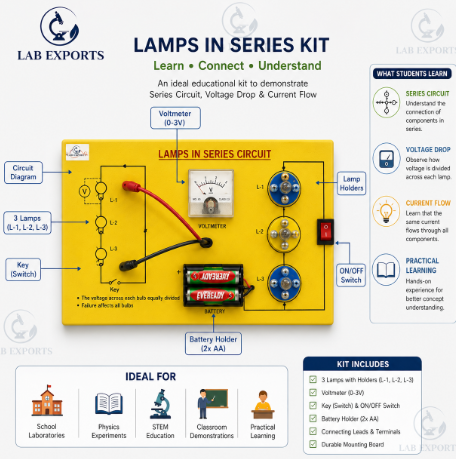
Galvanometer
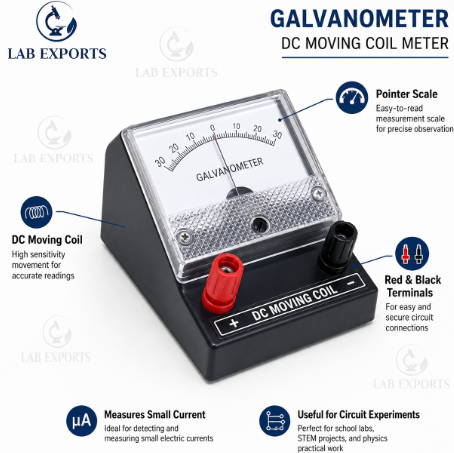
Product Code : SCL-EAE-11202
Quick answer: The Galvanometer is a sensitive current detector for physics practicals. Its pointer deflects when a small current flows, and the direction of deflection shows the direction of the current. It is used mainly as a null detector in Wheatstone bridge, metre bridge and potentiometer experiments, and in induction demonstrations. Lab Exports manufactures it in Delhi for schools, colleges and universities.
Specifications
| Parameter | Detail |
|---|---|
| Function | Detects small currents and shows their direction |
| Main use | Null detector in bridge and potentiometer experiments |
Range, sensitivity, scale and case details are not listed on this page; email [email protected] with the house code for the current model.
How the galvanometer is used
In a moving-coil galvanometer, current through a coil placed in a magnetic field produces a torque that turns the coil and pointer against a control spring, so the deflection is proportional to the current. Because it responds to very small currents, it is ideal for finding the balance point of a circuit, where the current through it becomes zero.
- Connect the galvanometer in the branch where the null or the current is to be detected, with a tapping key in series.
- Keep a high resistance in series, or a shunt across it, at first to protect it from large currents.
- Tap the key briefly and note the direction of deflection.
- Adjust the circuit until tapping produces no deflection; this is the null point.
Typical practicals include the Wheatstone and metre bridge, potentiometer comparison of EMFs and internal resistance, finding galvanometer resistance by the half-deflection method, and showing the induced current when a magnet moves in and out of a coil.
Key features
- Detects small currents in low-current teaching circuits
- Pointer deflection shows the direction of current
- Well suited to null detection in bridge and potentiometer work
- Makes electromagnetic induction visible with a coil and magnet
- Terminals allow quick insertion into an experimental circuit
- Reusable for regular practical sessions within its rated range
Documentation and supply
Most Lab Exports products carry a one-year manufacturer warranty.
Lab Exports manufactures the galvanometer at its works in Laxmi Nagar, Delhi, and supplies it to schools, colleges and universities in India and 60+ countries, handling the export documents for each shipment. More about the company is on the About Lab Exports page.
Related Electrical and Electronics products
- Conversion of Galvanometer (SCL-EAE-11201)
- LDR Characteristics Apparatus (SCL-EAE-11203)
- Good and Bad Conductor of Electricity (SCL-EAE-11200)
- Digital Panel Meter (SCL-EAE-11204)
- Step Down Transformer (SCL-EAE-11207)
- Domestic Circuit Apparatus (SCL-EAE-11196)
The full range is in the Electrical and Electronics section of the Physics Lab range.
Frequently asked questions
What is a galvanometer used for in the physics lab?
It detects small currents and their direction. Its main use is as a null detector in Wheatstone bridge, metre bridge and potentiometer experiments.
How is a galvanometer protected during an experiment?
Use a tapping key so current flows only briefly, and keep a high series resistance or a shunt in the circuit until the reading is close to the balance point.
What is the price of the galvanometer?
Prices are not published on the website. Add the galvanometer to the Enquiry Cart with the Add To Cart button on this page, or email [email protected] with the house code SCL-EAE-11202 and the quantity, to receive a quotation.
Does Lab Exports manufacture the galvanometer?
Yes. Lab Exports manufactures the galvanometer at its works at 11/315, Lalita Park, Laxmi Nagar, Delhi 110092, under house code SCL-EAE-11202.
Request a quote
Email [email protected] with the house code SCL-EAE-11202 and the quantity, or add the galvanometer to the Enquiry Cart with the Add To Cart button on this page. Tender buyers can also see the Tenders and OEM page.