Resonance Strips Model
Product Code : SCL-EAE-11127
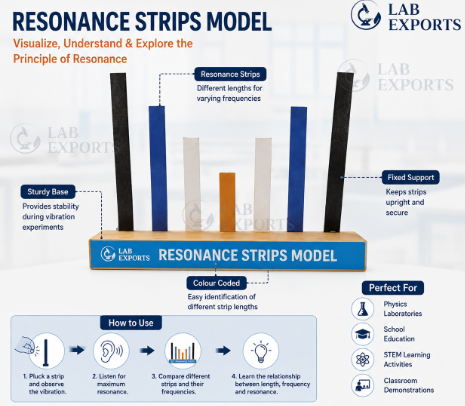
Quick answer: The Resonance Strips Model is a classroom demonstration of mechanical resonance. When the model is set vibrating, each strip responds according to its own natural frequency, and the strip whose natural frequency matches the applied vibration swings with the largest amplitude. Teachers use it to separate ordinary forced vibration from resonance. Lab Exports manufactures it in Delhi for schools, colleges and universities.
Specifications
| Parameter | Detail |
|---|---|
| Format | Single educational demonstration model |
| Principle | Mechanical resonance |
| Concepts covered | Natural frequency, forced vibration, resonance, amplitude, oscillation, energy transfer |
For the number of strips and the base and excitation arrangement, email [email protected] with the house code SCL-EAE-11127.
How the model is used in teaching
Every object that can vibrate has a natural frequency set by its physical properties, such as length, stiffness and mass. When a periodic force drives a system, each part is made to vibrate at the driving frequency, but most parts respond only weakly; this is forced vibration.
When the driving frequency matches the natural frequency of one strip, energy is transferred to it most efficiently and its amplitude grows far larger than that of the others: this is resonance. Changing the driving frequency makes a different strip respond, which shows students that resonance is selective.
- Place the model securely on a stable bench or demonstration table.
- Point out the differences between the strips before starting.
- Apply the vibration gently and hold it at a steady rate.
- Ask students which strip moves with the largest amplitude, then change the rate and observe again.
Everyday examples help the idea stick: a swing pushed in time with its motion, a wine glass set ringing by a sustained note, or soldiers told to break step when crossing a bridge.
Key features
- Makes resonance visible as a strong increase in amplitude.
- Shows that vibrating elements with different physical characteristics have different natural frequencies.
- Separates forced vibration from resonance in one demonstration.
- Lets the class compare the movement of several strips at once.
- Supports explanation of efficient energy transfer at the natural frequency.
Documentation and supply
Most Lab Exports products carry a one-year manufacturer warranty.
Lab Exports manufactures the resonance strips model at its works in Laxmi Nagar, Delhi, and supplies it to schools, colleges and universities in India and 60+ countries, handling the export documents for each shipment. More about the company is on the About Lab Exports page.
Related Electrical and Electronics products
- K Constant Spring (SCL-EAE-11126)
- Laser Ray Box (SCL-EAE-11128)
- Copper Voltameter (SCL-EAE-11125)
- Tuning Fork Set of 8 - Welch (SCL-EAE-11124)
- Solar Wind Dynamo Model (SCL-EAE-11130)
- Electrical Transformer (SCL-EAE-11122)
The full range is in the Electrical and Electronics section of the Physics Lab range.
Frequently asked questions
What does the Resonance Strips Model demonstrate?
It demonstrates mechanical resonance: the strip whose natural frequency matches the applied vibration responds with the largest amplitude.
What is the difference between forced vibration and resonance?
In forced vibration a body vibrates at the frequency of the applied force, usually with small amplitude. Resonance is the special case where that frequency equals the body's natural frequency, and the amplitude becomes large.
What is the price of the resonance strips model?
Prices are not published on the website. Add the resonance strips model to the Enquiry Cart with the Add To Cart button on this page, or email [email protected] with the house code SCL-EAE-11127 and the quantity, to receive a quotation.
Does Lab Exports manufacture the resonance strips model?
Yes. Lab Exports manufactures the resonance strips model at its works at 11/315, Lalita Park, Laxmi Nagar, Delhi 110092, under house code SCL-EAE-11127.
Request a quote
Email [email protected] with the house code SCL-EAE-11127 and the quantity, or add the resonance strips model to the Enquiry Cart with the Add To Cart button on this page. Tender buyers can also see the Tenders and OEM page.