Copper Voltameter

Product Code : SCL-EAE-11125
Quick answer: The copper voltameter is an electrolysis apparatus used to verify Faraday's first law and to find the electrochemical equivalent (ECE) of copper. A measured direct current is passed between copper electrodes in a copper-containing electrolyte, and the mass of copper deposited on the cathode is related to the charge passed. Lab Exports manufactures it in Delhi for schools, colleges and universities.
Specifications
| Parameter | Detail |
|---|---|
| Format | Single electrolysis apparatus |
| Principle | Electrolysis, Faraday's laws of electrolysis |
| Measured relationship | Electric charge passed against mass of copper deposited |
| Main result | Electrochemical equivalent of copper |
For electrode configuration, dimensions and accessories, email [email protected] with the house code SCL-EAE-11125.
How the copper voltameter experiment is done
Faraday's first law states that the mass of a substance deposited at an electrode is proportional to the charge passed: m = Z I t, where I is the current in amperes, t the time in seconds and Z the electrochemical equivalent. In the copper voltameter, copper dissolves from the anode and deposits on the cathode, so the gain in mass of the cathode gives m directly.
- Clean the cathode plate, dry it and weigh it accurately.
- Fill the voltameter with copper sulphate solution, the usual electrolyte, and set the electrodes in place.
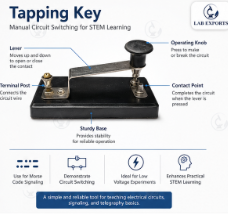
- Connect a battery, rheostat, ammeter and key in series with the voltameter, cathode to the negative terminal.
- Pass a steady current for a measured time, keeping the ammeter reading constant with the rheostat.
- Remove the cathode, rinse it gently, dry it and weigh it again.
- Calculate Z = m/(I t) and compare it with the standard value of about 3.29 x 10^-7 kg per coulomb.
A clean, even deposit gives the best result, so a moderate current is used; too high a current density gives a loose, dark deposit that can flake off before weighing.
Key features
- Demonstrates copper transfer from anode to cathode as direct current flows.
- Supports verification of Faraday's first law of electrolysis.
- Allows the electrochemical equivalent of copper to be calculated from mass, current and time.
- Electrode mass before and after electrolysis gives a direct, measurable result.
- Useful in physics, chemistry and electrochemistry practicals.
Documentation and supply
Most Lab Exports products carry a one-year manufacturer warranty.
Lab Exports manufactures the copper voltameter at its works in Laxmi Nagar, Delhi, and supplies it to schools, colleges and universities in India and 60+ countries, handling the export documents for each shipment. More about the company is on the About Lab Exports page.
Related Electrical and Electronics products
- Tuning Fork Set of 8 - Welch (SCL-EAE-11124)
- K Constant Spring (SCL-EAE-11126)
- Resonance Strips Model (SCL-EAE-11127)
- Electrical Transformer (SCL-EAE-11122)
- Laser Ray Box (SCL-EAE-11128)
- Dynamo Model AC DC (SCL-EAE-11120)
The full range is in the Electrical and Electronics section of the Physics Lab range.
Frequently asked questions
What is a copper voltameter used for?
It is used to verify Faraday's laws of electrolysis and to determine the electrochemical equivalent of copper from the mass deposited, the current and the time.
What is the electrochemical equivalent of copper?
It is the mass of copper deposited by one coulomb of charge, about 3.29 x 10^-7 kg per coulomb (0.000329 g per coulomb).
What is the price of the copper voltameter?
Prices are not published on the website. Add the copper voltameter to the Enquiry Cart with the Add To Cart button on this page, or email [email protected] with the house code SCL-EAE-11125 and the quantity, to receive a quotation.
Does Lab Exports manufacture the copper voltameter?
Yes. Lab Exports manufactures the copper voltameter at its works at 11/315, Lalita Park, Laxmi Nagar, Delhi 110092, under house code SCL-EAE-11125.
Request a quote
Email [email protected] with the house code SCL-EAE-11125 and the quantity, or add the copper voltameter to the Enquiry Cart with the Add To Cart button on this page. Tender buyers can also see the Tenders and OEM page.